TL;DR
AI chatbots in 2026 go beyond conversations and handle real workflows across support, sales, and operations.
Businesses use them to automate tasks, reduce manual work, and improve response speed without increasing team size.
The most effective platforms connect with internal systems and focus on resolving requests, not just replying.
Platforms like YourGPT combine chat with workflow execution to deliver measurable business outcomes.
AI chatbots are now a must-have for any business aiming to improve customer service and boost sales. They answer everyday questions fast, help them qualify leads, and take care of bookings or appointments.
A few years back, it took an entire team to manage these tasks. Now, a single AI agent can do them all. Customer expectations have shifted too; more than half of people now prefer using an AI agents instead of waiting for a human for simple requests.
Of course, not every chatbot is right for every business. A small online store will have different need than a large company managing customer support for thousands of users. The best chatbot is the one that matches your goals, integrates with your current tools and help you improve your KPI’s.
The wrong choice leads to wasted time, unnecessary costs, and unhappy customers.
This article explains how to choose the right chatbot for your business. It covers the main types of chatbots, their best uses, and compares the top platforms in 2026 by features, pricing, and real-world examples.
What is AI Chatbot Software (and Why Businesses Use It in 2026)
Support software includes tool or system used by businesses to manage customer inquiries, resolve issues, and communicate effectively. Typically, when support queues start growing, companies respond by adding more agents to the team. That can help temporarily, but it’s not the only option.
Look at an e-commerce inbox. Around 30% of customers just ask about order status. Another 15% have questions about returns or refunds. The remaining queries usually involve basic troubleshooting. Nearly all of these repetitive questions can be automated.
Modern chatbot software goes beyond matching keywords. It understands what customers are actually writing. If someone asks about shipping and then shifts suddenly to refunds, the chatbot naturally adapts, following the conversation as it evolves.
Moving Beyond Traditional Rule-Based Systems
Traditional rule-based chatbots follow fixed scripts.
Think about a telecom provider that faces the same questions daily about dropped connections, slow speeds, or router resets. A scripted chatbot can handle these standard scenarios easily, stepping customers through common solutions and escalating to human agents when needed.
But these scripted bots quickly reach their limits. Even slight deviations in phrasing or uncommon scenarios throw them off, forcing customers to repeat themselves or start over. While some predictable workflows can still benefit from scripted interactions, businesses now rarely depend solely on these traditional solutions.
AI Agents—Where Chatbots Are Heading
AI agents are changing how chatbots work by performing tasks rather than just answering questions.
Say a customer wants to return a product. Older chatbots would send a link to a return form, shifting effort back to the customer. An AI agent directly manages the return process during the conversation itself. It checks the return eligibility, generates shipping labels, updates inventory, and schedules pickup, handling everything in real-time without breaking interaction.
Behind the scenes, AI agents integrate directly with internal databases, billing platforms, and inventory systems. Complex processes that once required collaboration across multiple teams can now be solved instantly.
Perhaps the most valuable advantage is their ability to handle unexpected or complicated requests. While older rule-based bots stall when confronted with new scenarios, AI agents adapt. They don’t get it perfect every single time, but they’re far less likely to default to an unhelpful “I don’t understand.”
Why Your Business Needs a Chatbot in 2026
Chatbots are no longer just a support tool. They have become a core part of how businesses interact with customers, generate revenue, and manage internal processes. From customer service to sales to HR automation, chatbots help companies scale efficiently while keeping costs under control.
1. Customer Support
Customers now expect businesses to be available around the clock. Chatbots make this possible by reducing response times, handling repetitive questions, and guiding people to the right resources instantly. They also reduce ticket volume by resolving common issues instantly, which improves customer satisfaction and lowers support costs.
2. Lead Generation
Instead of waiting for a form submission, chatbots can qualify leads in real time. They capture contact details, identify intent, and hand prospects directly to sales teams, turning website traffic into real opportunities. This shortens the sales cycle and ensures your team spends time on high-intent prospects instead of cold leads.
3. HR Automation
Within companies, chatbots save HR teams hours of repetitive work. They can answer common employee questions such as leave balances, policies, or feedback requests, which frees HR staff to focus on strategic initiatives. They also ensure consistent responses across the organization, reducing errors and improving employee experience.
4. Appointment Scheduling
Scheduling no longer requires back-and-forth emails. With a chatbot, customers can check availability, confirm times, and book appointments instantly, improving both speed and convenience. This reduces missed opportunities and keeps calendars organized without manual coordination.
5. Financial and Operational Assistance
Modern chatbots do more than answer questions. They provide account updates, generate reports, and even assist with financial queries. This makes them valuable not only for customer interactions but also for internal teams managing operations. By connecting with internal systems, they help teams access real-time data and make faster, informed decisions.
The best AI Chatbot Software at a glance
| Platform Name | Best For | AI Model | Starting Price |
|---|---|---|---|
| YourGPT | Unified AI platform for support, sales, and ops across web, WhatsApp, email, voice | Multi-LLM (GPT-4o, Claude, Gemini, Llama, Qwen, +) | Tiered plans / quote |
| ManyChat | Marketing automation on Instagram, WhatsApp, and Messenger | Rule-based flows; optional AI via integrations | Entry plan available |
| Gupshup | High-volume conversational commerce and transactional messaging | LLM-agnostic (OpenAI and others) + in-house tools | Usage-based / quote |
| Kore.ai | Enterprise conversational AI with security, compliance, voice + chat | Proprietary NLP + LLM connectors | Contact sales |
| Leena AI | HR automation and employee self-service at scale | LLM-powered (model-agnostic) | Contact sales |
| Yellow.ai | Global, multilingual customer engagement across 35+ channels | Generative AI + industry NLP; LLM-hybrid | Contact sales |
| Chatfuel | Simple automation for Instagram and Messenger DMs | Rule-based with AI add-ons via APIs | Entry plan available |
Best AI Chatbot Software in 2026 (Top 7 Platforms Ranked)
The chatbot market is crowded, and every platform promises powerful AI and automation. To help you cut through the noise, this ranked list highlights the top software in 2026, complete with features, pricing, and the business scenarios where each one performs best.
1. YourGPT – AI-first platform with no-code bot creation, Human In the Loop, omnichannel support (Web, WhatsApp, Instagram, Slack), advanced RAG-based AI, and real-time analytics.
2. ManyChat – Marketing-driven chatbot built for Messenger, WhatsApp, and Instagram. Perfect for automated campaigns, lead capture, and social media sales funnels.
3. Gupshup – Conversational messaging platform at scale, supporting WhatsApp, SMS, and RCS. Strong for transactional workflows, eCommerce, and customer engagement.
4. Kore.ai – Enterprise-grade AI chatbot with advanced NLP, compliance features, and omni-channel deployment (voice, web, Teams, Slack). Suited for organizations needing secure, large-scale automation.
5. Leena AI – HR-focused chatbot that answers employee FAQs, manages leave requests, and automates HR workflows. Helps reduce repetitive tasks for internal teams.
6. Yellow.ai – Global AI chatbot platform supporting 135+ languages and multi-channel engagement. Known for generative AI workflows tailored to specific industries like retail, banking, and healthcare.
7. Chatfuel – Easy-to-use chatbot for Instagram and Facebook Messenger. Automates DMs, FAQs, and sales processes for small to mid-sized businesses that rely heavily on social media.
1. YourGPT

YourGPT is a complete AI-first platform built for modern customer support, sales, and business operations.
It allows businesses to build, train, and deploy custom AI agents across web, email, WhatsApp, Telegram, and other channels without coding. These agents go beyond basic chat by connecting with your data and systems in real time to automate customer support, drive sales, and handle internal operations.
With no-code tools, you can train agents on your own data such as PDFs, websites, Notion, and Google Sheets, and design workflows that execute real tasks like order updates, lead qualification, and appointment booking. YourGPT brings everything into one system so teams can resolve requests faster, reduce manual work, and keep every interaction consistent across channels.
Features
- No-Code AI builder to build, train, and customize agents
- Advanced RAG AI that train directly on business data from PDFs, Notion docs, web pages, help centers, and Google Sheets.
- Automated workflows for FAQs, lead capture, bookings, and product recommendations
- Multilingual support across 100+ languages
- Omnichannel integration Web, Email, Phone, WhatsApp, Instagram, Slack, Telegram, LINE & more.
- SOC2-compliant data handling and enterprise-grade security (in progress)
Pros
- Code-free setup – build, launch, and optimize AI agents without technical skills
- Most advanced AI Platform – from AI agents to voice AI, AI studio, AI helpdesk, and analytics
- Fully customizable – train on your data, adjust workflows, and brand every detail to match your business
- Action-oriented AI – goes beyond chatting with the ability to perform tasks, calling APIs, update CRMs, process orders, manage inventory, and trigger workflows across your business systems.
- Enterprise-grade compliance – built with strong privacy, SOC 2 readiness, and secure data handling
Cons
- Voice AI and workflow builder may require onboarding support for optimal use
- All features are not available on trail.
Best For
Businesses looking for a single AI platform to unify support, sales, and operations across multiple channels with minimal technical overhead.
2. ManyChat
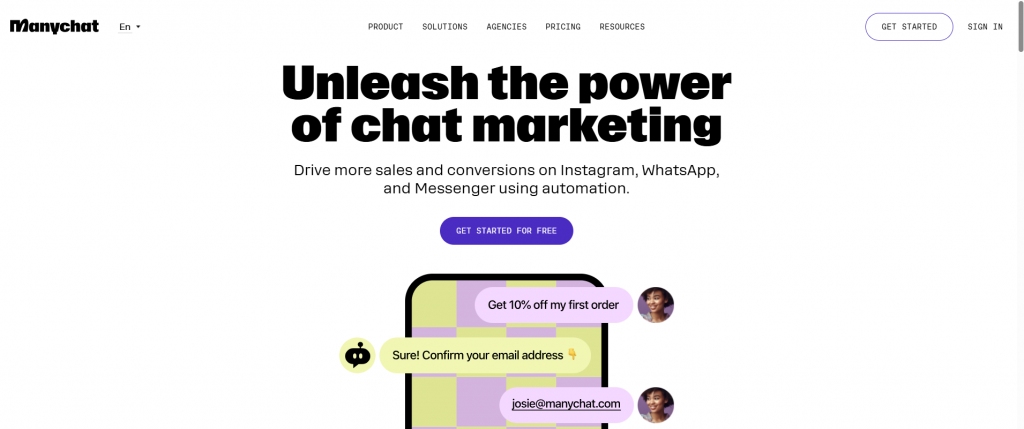
ManyChat is a marketing automation platform built for social channels like Instagram, WhatsApp, and Facebook Messenger.
It helps businesses design customer journeys, capture leads, and run automated campaigns without coding. With its visual Flow Builder, teams can create message sequences, trigger responses based on user actions, and manage conversations at scale across social platforms.
ManyChat is commonly used for driving engagement, nurturing leads, and handling high-volume messaging, especially for businesses focused on social-first growth and campaign-based interactions.
Features
- Visual drag-and-drop Flow Builder for easy automation
- Seamless integrations with Instagram, WhatsApp, and Facebook Messenger
- Prebuilt templates for lead capture, eCommerce, and customer support
- Broadcast and drip campaigns for customer engagement
- Integrates with Shopify, HubSpot, Zapier, and other marketing tools
Pros
- Beginner-friendly, no coding required
- Strong focus on social commerce and engagement
- Affordable entry-level plans for small businesses
Cons
- Limited advanced AI capabilities compared to enterprise platforms
- Best suited for marketing automation, not complex operations
Best For
Small to mid-sized businesses looking to increase engagement and sales through social messaging platforms.
3. Gupshup
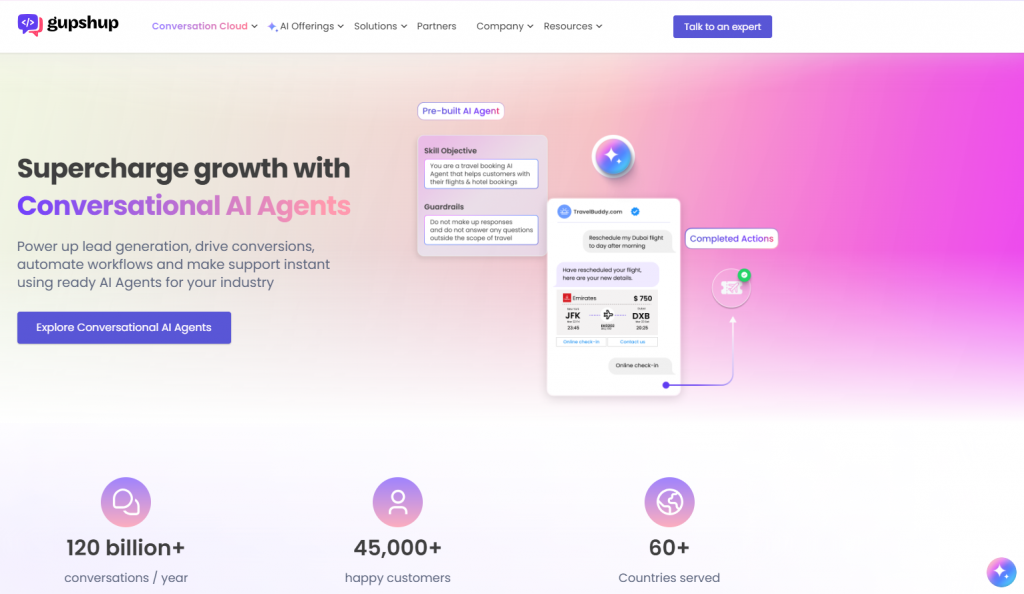
Gupshup is a conversational messaging platform designed for commerce and customer engagement across multiple channels.
It enables businesses to build and manage messaging experiences on platforms like WhatsApp, SMS, and other communication channels, with a focus on scalability and automation. Using its Auto Bot Builder, teams can generate conversational flows directly from a website URL or existing business content, reducing setup time and effort.
Gupshup is often used for transactional messaging, customer notifications, and commerce-driven interactions where businesses need reliable messaging infrastructure combined with automation.
Features
- Supports WhatsApp, SMS, RCS, Instagram, and more
- Generative AI bot builder for quick setup
- Tools for conversational commerce, marketing, and support
- Rich media support for payments, catalogs, and interactive cards
- Enterprise-grade scalability with strong presence in BFSI and retail
Pros
- Wide coverage of messaging channels
- Focused on commerce and transaction-driven experiences
- Fast bot creation with AI-assisted tools
Cons
- Less emphasis on deep workflow automation
- Pricing may be complex for smaller businesses
Best For
Enterprises in retail, fintech, and eCommerce that need high-volume, multi-channel engagement.
4. Kore.ai
Kore.ai is an enterprise-grade conversational AI platform built for secure, large-scale deployments across customer service, employee support, and business operations.
It provides advanced natural language processing (NLP), allowing businesses to handle complex queries with high accuracy. Teams can design highly customizable workflows, integrate with internal systems, and automate both customer-facing and internal processes.
Kore.ai also offers industry-specific solutions tailored for sectors like banking, healthcare, and retail, making it suitable for organizations that require compliance, scalability, and deep customization in their AI
Features
- Advanced NLP and dialog management for complex use cases
- Prebuilt industry templates (banking, healthcare, retail)
- Multimodal experiences including chat, voice, and IVR
- AI-powered analytics for tracking customer intent and outcomes
- Integrations with CRMs, ERPs, and ticketing systems
Pros
- Enterprise-grade customization and scalability
- Robust compliance and data security features
- Strong industry-specific focus
Cons
- Steeper learning curve for setup and customization
- Higher cost compared to SMB-friendly platforms
Best For
Large enterprises that require secure, compliant, and deeply customizable AI deployments.
5. Leena AI
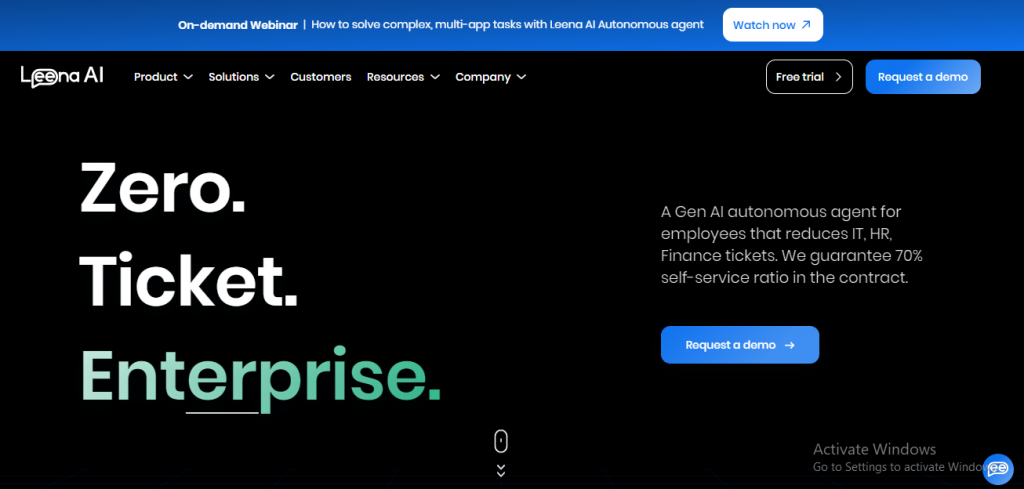
Leena AI is a conversational AI platform focused on automating HR operations and improving employee experience.
It helps organizations handle internal queries, manage HR workflows, and reduce manual effort across routine processes. From answering employee FAQs to automating tasks like leave requests, onboarding support, and policy updates, Leena AI streamlines day-to-day HR operations.
The platform is designed for internal use, making it a strong fit for teams looking to centralize employee support, improve response times, and maintain consistency across HR processes.
Features
- AI-driven HR assistant for employees
- Automates processes like leave management, payroll queries, and onboarding
- Integrates with HRIS platforms like Workday and SuccessFactors
- Provides insights into employee engagement and feedback
- Multi-language support for global teams
Pros
- Specialized focus on HR and workplace automation
- Saves HR teams time on repetitive tasks
- Simple integrations with enterprise HR tools
Cons
- Narrower focus compared to general-purpose chatbot platforms
- Limited utility outside HR and employee-facing use cases
Best For
Enterprises looking to improve HR efficiency and employee experience with an AI-powered assistant.
6. Yellow.ai

Yellow.ai (formerly Yellow Messenger) is an enterprise conversational AI platform built for global customer engagement across multiple channels.
It enables businesses to deploy AI agents across web, mobile, messaging apps, and voice, with strong multilingual capabilities to support diverse audiences. The platform is designed to handle large-scale interactions while maintaining consistent experiences across touchpoints.
With its focus on omnichannel communication, automation, and language support, Yellow.ai is well-suited for companies operating across regions that need unified customer interactions at scale.
Features
- Supports 135+ languages with AI-powered translation
- Deploys across 35+ channels including WhatsApp, Teams, and Slack
- Generative AI tools (YellowG) for dynamic workflows
- Industry-focused solutions for BFSI, telecom, healthcare, and retail
- AI-powered analytics and reporting
Pros
- Excellent multilingual and multi-channel support
- Strong enterprise adoption across industries
- Scalable deployments for global businesses
Cons
- Can be complex to implement without technical expertise
- Premium pricing targeted at large enterprises
Best For
Global enterprises needing multilingual, multi-channel AI chatbots for customer support and operations.
7. Chatfuel
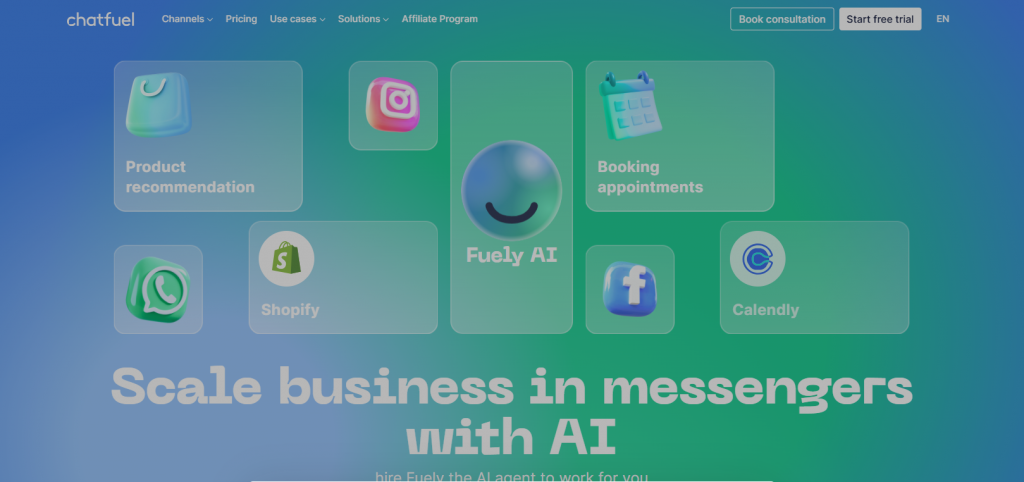
Chatfuel is designed primarily for building AI chatbots on Facebook Messenger and Instagram. It’s a popular choice for businesses looking to automate conversations directly within social platforms.
It allows teams to create automated replies, lead capture flows, and marketing sequences without coding. With built-in templates and integrations, businesses can quickly launch bots for customer engagement, sales inquiries, and campaign automation.
Chatfuel is especially useful for brands focused on social media-driven growth, where fast responses and automated interactions help maintain engagement at scale.
Features
- AI chatbot builder for Messenger and Instagram
- Lead capture and qualification tools
- Automates FAQs and provides product recommendations
- Integrates with Facebook Ads for seamless campaigns
- Supports integrations with CRM and email marketing tools
Pros
- Easy to set up and manage
- Strong social media focus
- Affordable pricing for SMBs
Cons
- Limited functionality outside Messenger and Instagram
- Less suitable for enterprise-scale use
Best For
Businesses focused on social media marketing and engagement through Facebook and Instagram.
Comparison Table: Top Chatbot Platforms 2026
This table highlights the best use cases, supported channels, no-code capabilities, AI features, and language options so you can quickly compare and choose the right chatbot for your business.
| Chatbot | Best For | AI Capabilities | Customization & Controls | User Feedback Highlights |
|---|---|---|---|---|
| YourGPT | Enterprise-grade automation for support, sales, operations | Document-heavy workflows, retrieval logic, AI-assisted agents | Highly customizable, API-driven, granular permissions | Learnable, accurate, improves CX; setup can be technical (bigsur.ai) |
| Kore.ai | Enterprise conversational AI with security and compliance | Advanced NLP, logic-based AI agents | Industry templates, UX design for virtual agent workflows | Robust compliance, widely used in IT and support automation |
| Leena AI | Human Resources automation and internal employee support | AI-powered HR workflows and knowledge automation | HR-focused templates and process automations | Favored in regulated sectors for HR-specific automation (Gartner) |
| Yellow.ai | Global, multilingual customer engagement at scale | Generative AI workflows and industry-specific NLP | Extensive multi-language and channel support | Strong global reach; onboarding complexity noted |
| ManyChat | Marketing automation and social media sales funnels | Rule-based flows with basic automation | No-code builder optimized for social campaigns | Easy and effective for SMB social automation; broad adoption |
| Gupshup | Conversational commerce and transactional messaging at scale | Agentic AI features, dynamic routing, LLM-based generation | Pre-built workflows, business messaging integrations | Strong ROI, recognized for scale in BFSI and retail |
| Chatfuel | Simple automation for Messenger and Instagram | Keyword matching with basic personalization | Quick to build and deploy on social platforms | Affordable and easy to use for SMB marketing |
How to Choose the Right AI Chatbot for Your Business
The best AI chatbot for your business is not the one with the most advanced features. It is the one that directly solves your biggest challenges.
Choosing the wrong tool can result in wasted money, frustrated teams, and poor customer experiences. Before making a decision, focus on these five areas:
1. Define Your Primary Use Case
Start with the outcome that matters most:
- Customer Support: Choose bots that handle FAQs, reduce ticket volume, and escalate to human agents when required.
- Sales and Lead Generation: Select platforms with CRM integrations, lead qualification, and scheduling.
- HR Automation: Use chatbots that answer internal FAQs, manage policies, and support onboarding.
- Marketing: Look for tools that provide personalization, campaign triggers, and multi-channel outreach.
2. Check Integration Capabilities
A chatbot should fit into your existing tech stack. Confirm that it connects with your CRM, eCommerce platform, helpdesk, and analytics tools. Poor integration often leads to more manual work.
3. Balance Ease of Use with Flexibility
- Small teams: No-code builders with drag-and-drop editors are ideal.
- Technical teams: Platforms with advanced customization and developer options may be a better fit.
Choose according to your team’s resources and skills.
4. Evaluate Scalability and ROI
Think about long-term growth. Can the platform manage more conversations as your customer base expands? Does the pricing scale fairly with usage? Compare the cost against potential ROI in staff time saved, faster sales cycles, and improved customer satisfaction.
5. Prioritize Analytics and Insights
A good chatbot does more than just respond to questions. It should also provide valuable insights. Look for reporting tools that show performance metrics, identify drop-off points, track customer sentiment, and highlight trends in user queries. With these insights, you can continuously improve both the chatbot and the customer experience.
FAQ
What is an AI agent and how is it different from a chatbot? ▼
An AI agent goes beyond answering questions. It can complete tasks during the conversation such as booking appointments, qualifying leads, processing refunds, or automating workflows. Traditional chatbots mostly follow scripts and handle simple FAQs.
Why are businesses moving to AI agents in 2026? ▼
AI agents reduce costs, improve efficiency, and deliver faster support by taking action instead of only providing answers. They help with support, workflow automation, bookings, lead qualification, and HR requests in one continuous interaction.
What tasks can AI agents handle today? ▼
Common tasks include customer support responses, ticket triage, booking appointments, lead capture and qualification, HR FAQs, policy lookups, account updates, and simple report generation.
How do I choose the right AI agent for my business? ▼
Define your main goal first such as lowering ticket volume, generating leads, or automating HR workflows. Shortlist platforms that integrate with your tools, match your budget, and scale with usage. Run a small pilot before a full rollout.
Can AI agents replace human teams? ▼
No. AI agents are best for repetitive tasks and real-time actions. Humans are still required for complex, sensitive, or high-value cases. A combined approach gives the best results.
How much does AI agent software cost? ▼
Entry plans typically start around $15–$30 per month. Mid-range solutions with CRM integrations and analytics range from $50–$200 per month. Enterprise plans with compliance and large-scale automation can cost several hundred dollars monthly or use usage-based pricing.
What is the ROI of using AI agents? ▼
ROI comes from lower staffing costs, faster resolutions, ticket deflection, and higher conversion rates. As more workflows are automated, the gains compound and the payback period shortens.
Which industries gain the most from AI agents? ▼
High-impact use cases appear in ecommerce, banking and fintech, healthcare, telecom, and HR. Typical wins include order tracking, account assistance, patient scheduling, troubleshooting, and employee self-service.
Do I need coding skills to deploy an AI agent? ▼
Most modern platforms offer no-code builders for setup and training. Coding helps when you want custom integrations or complex workflows, but it is not required for basic deployments.
How do I measure the success of an AI agent? ▼
Track response times, resolution rate, ticket deflection, customer satisfaction, conversion rate, and drop-off points. Use the platform’s analytics to identify improvements and iterate.
Conclusion
Chatbots are starting to transition into AI agents. In 2026, many businesses now use AI agents to handle tasks like support, workflow automation, booking appointments, qualifying leads, supporting HR teams, and helping customers. When implemented well, AI agents reduce costs, improve efficiency, and provide customers with quick support.
Choosing the right AI agent means looking at your business goals, not just a list of features. Identify your main needs, such as lowering support ticket volume, generating new leads, or automating specific workflows. After that, review platforms that align with your priorities and test them with a small pilot before making a full decision.
Platforms like YourGPT fit well in this shift by combining no-code AI agent building with real-time integrations, allowing businesses to move beyond conversations and actually complete tasks across support, sales, and operations. This makes it easier to connect AI with real workflows instead of keeping it limited to responses.
Selecting an AI agent that matches your requirements helps you see faster ROI, improve customer satisfaction, and free your team to focus on work that requires human judgment.
Create a AI Chatbot for Your website within 2 mintues
Join thousands of businesses transforming customer support with YourGPT AI
- ⚡️ 5-minute setup
- 🌐 Multi-lingual
- 🗣️ Voice Support
- 🔌 Omni-Channel Integration
No credit card required • Full access • Limited time offer
Leave a Reply