TL;DR
Enterprise chatbots and AI agents now handle both conversations and real tasks across support, sales, and operations.
The most effective platforms connect with your systems and focus on resolving requests, not just responding to them.
Start with a high-impact use case, track outcomes, and expand only after results are proven.
Platforms like YourGPT show how combining chat with workflow execution drives measurable business value.
The way enterprises communicate and operate has changed dramatically in 2026. Customers expect answers instantly, employees want faster support from internal teams, and business leaders are under pressure to cut costs without slowing growth.
Meeting all of these demands at scale is no longer possible with traditional tools. Basic chatbots that simply respond to questions are no longer enough. This is why enterprises are rapidly shifting toward AI agents: autonomous systems that don’t just answer queries but take action, execute multi-step workflows, and operate across tools and systems with minimal human intervention.
The enterprise AI agent market reflects this urgency. Grand View Research has projected that the broader conversational AI market will surpass $27.29 billion by 2030, and AI agents are at the center of that growth.
Today’s leading platforms do far more than respond to simple questions. They integrate directly with CRMs, ERPs, and collaboration tools. They autonomously execute repetitive workflows across departments. They support multilingual, global operations and surface insights that drive smarter business decisions. In short, the right AI agent is no longer just a support tool, it is a growth engine.
But with a crowded market and plenty of overpromises, the challenge for enterprises is knowing which platform actually delivers.
This guide doesn’t just list platforms. It helps you:
- Identify the AI agent platform that drives the most ROI for your unique enterprise setup.
- Evaluate vendors based on autonomy, integration, scalability, and business impact.
- Compare the top 6 enterprise AI agent platforms based on real-world use cases.
You’ll learn how to evaluate solutions against real business needs, see which benefits matter most in 2026, and explore a side-by-side look at the platforms leading the way.
How to Evaluate the Best Chatbot Solution for Your Enterprise
Selecting the right chatbot comes down to one question: will it fit your business needs and grow with you? A strong enterprise chatbot does more than answer questions. It integrates with your systems, adapts to different teams, and delivers measurable results, often requiring a kubernetes expert to support scaling, orchestration, and long-term reliability. Use this checklist to guide your decision.
1. Define Your Use Cases
Start by being clear about what you need the chatbot to do. Chatbots serve different purposes across enterprises:
- Customer support: Answer FAQs, resolve issues, and manage escalations.
- Sales: Qualify leads, capture information, and schedule meetings.
- Employee self-service: Help with HR questions, IT troubleshooting, or policy lookups.
- Transactions: Process orders, handle payments, or verify details.
If your business needs fast deployment, look for platforms with ready-to-use templates. If you need unique workflows, choose one that offers deeper customization.
2. Check Integration Capabilities
The best chatbot won’t help if it doesn’t connect to your core tools. A good platform should:
- Sync with your CRM and customer databases.
- Connect to ERP systems for consistent operations.
- Support multiple channels like web, mobile, WhatsApp, Teams, Slack, and voice.
- Provide secure options for authentication and compliance.
Smooth integration prevents data silos and allows different departments to work from the same information.
3. Review Vendor Support and Ecosystem
Even the best technology needs strong support. Look for vendors who will act as partners, not just providers.
- Support levels: Ask if they provide dedicated enterprise assistance, onboarding, and training.
- Developer tools: APIs, SDKs, and clear technical guides for your IT team.
- Community: Active forums, knowledge bases, and peer groups that help you solve problems faster.
A reliable vendor and an engaged user base make it easier to resolve issues, improve performance, and keep pace with AI advancements.
Top Business Drivers for Enterprise Chatbot Adoption in 2026
Enterprises have moved past experimenting with chatbots and AI agents. They are making them a core part of digital strategy. In 2026, the decision to adopt AI agents is driven by clear business needs and measurable outcomes.
1. Managing High-Volume Interactions Efficiently
Large organizations face thousands of repetitive requests every day, from order tracking to password resets. AI agents automate these tasks instantly and allow human teams to focus on more complex cases that require expertise and empathy. Unlike traditional chatbots, AI agents can handle multi-step requests end to end without escalation.
2. Meeting Expectations for 24/7 Availability
Customers now expect round-the-clock support, regardless of location. AI agents deliver instant responses across time zones and ensure no customer has to wait for help outside business hours. They do this autonomously, without any human backup needed for routine requests.
3. Maintaining a Consistent Brand Voice
AI agents provide reliable communication that reflects the brand’s tone and standards across every channel. This consistency builds trust and ensures customers receive accurate information whether they interact via web, mobile, or messaging apps. Because AI agents operate from a centralized knowledge base, every response stays on-brand and up to date.
4. Unlocking Value Across Departments
Enterprises deploy AI agents far beyond customer service. Marketing teams use them to qualify leads, HR teams to respond to employee inquiries, IT teams to troubleshoot issues, and operations teams to process transactions. This cross-department utility amplifies ROI and makes AI agents one of the highest-leverage investments an enterprise can make.
5. Reducing Costs While Improving Efficiency
Automation through AI agents reduces the need for large support teams, cutting costs by as much as 40 percent. At the same time, AI agents improve response times and increase customer satisfaction, delivering both cost savings and revenue impact. For instance, ScienceSoft’s HIPAA-compliant voice agent uses Amazon Nova Sonic for human-like scheduling. Integrating with EHR systems, it enables real-time booking without latency, aiming to reduce operational costs by 50% and increase call capacity by 70%.
Benefits of Enterprise Chatbots in 2026
Enterprise AI agents have evolved well beyond add-ons for customer support. In 2026, they play a central role in improving efficiency, engaging users, and generating business value across the organization.
1. Driving Organizational Efficiency
By deploying AI agents to handle routine tasks and inquiries, enterprises free employees to focus on complex and strategic work. For example, AI agents can instantly answer FAQs about company policies or client orders, allowing human agents to dedicate their time to high-value issues. This creates faster response times and leaner workflows.
2. Boosting Engagement for Customers and Employees
AI agents make interactions more dynamic and responsive. Customers benefit from immediate answers and personalized guidance, while employees can quickly access HR or IT information. Research shows that 83% of customers expect immediate engagement on a website, a need AI agents are uniquely equipped to meet.
3. Reducing Resolution Time for Support Tickets
For enterprises handling thousands of support queries daily, AI agents dramatically shorten ticket resolution times. They resolve common issues instantly, route complex ones to the right teams, and ease the workload on service agents. This improves customer experience while maintaining operational speed.
4. Cutting Operating Costs
Enterprises using AI agents often reduce service costs by up to 30%. Their ability to operate 24/7, handle high volumes simultaneously, and scale during peak demand lowers the need for additional staffing and improves cost efficiency.
5. Unlocking Real-Time Customer Insights
When paired with CRM and analytics platforms, AI agents turn every interaction into actionable data. They capture customer preferences, identify trends, and provide real-time insights for sales and marketing strategies. This enables smarter segmentation, targeted recommendations, and stronger engagement.
6. Powering Omnichannel Strategies
Today’s customers interact across multiple touchpoints such as websites, apps, social media, and messaging platforms. AI agents ensure consistent communication across all of them. This omnichannel presence not only supports customer convenience but also strengthens loyalty by creating seamless brand experiences.
Best Enterprise Chatbot Solutions in 2026
Here is a closer look at seven of the leading enterprise chatbot platforms in 2026, including their strengths, limitations, and best-fit scenarios.
YourGPT is an AI-first automation hub that unifies support, sales, and workflows with no-code bots, voice AI, and omnichannel deployment.
Kore.ai delivers pre-built, industry-ready assistants for banking, healthcare, and retail with strong compliance and rapid deployment.
Ada powers large-scale customer experience automation with proactive messaging, multichannel support, and reduced reliance on live agents.
Yellow.ai provides multilingual conversational AI in 135+ languages, ideal for global enterprises needing localized engagement.
Genesys integrates chatbot automation into its Cloud CX contact center platform, orchestrating customer journeys across chat and voice.
Salesforce Agentforce embeds AI-driven bots directly into Salesforce CRM for case deflection, lead qualification, and workflow automation.
Choosing the right AI chatbot platform depends on your business size, industry, and specific goals. Below are six leading platforms in 2026, each with unique strengths, features, and considerations to help you decide which one fits best.
1. YourGPT
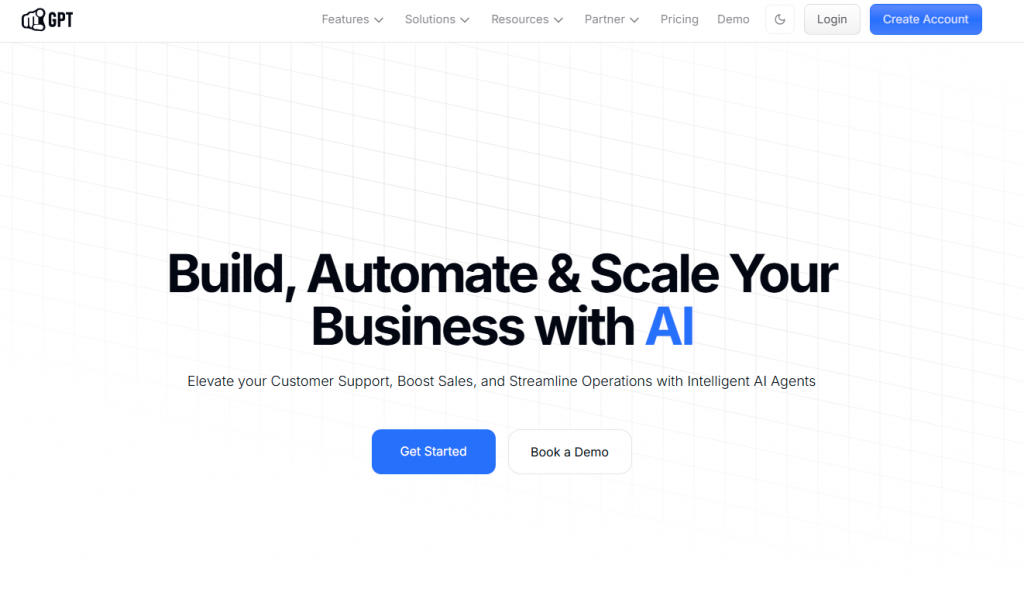
It helps businesses move beyond basic chat responses by enabling AI agents that can take real actions, not just answer questions. You can build no-code chatbots, train them on your own data such as PDFs, websites, Notion, and Google Sheets, and deploy them across web, WhatsApp, Instagram, Messenger, and more.
With its AI Studio, you can design workflows, connect APIs, automate tasks like order updates, refunds, lead qualification, and appointment booking, all from one place. The platform also includes a unified inbox for managing conversations, seamless human handoff with full context, and real-time analytics to track performance.
YourGPT is built for teams that want faster resolutions, lower support costs, and a system that actually completes tasks, not just conversations.
Features
- No-code agent builder with drag-and-drop design.
- Train chatbots on PDFs, websites, Notion, and Google Sheets.
- Omnichannel inbox for WhatsApp, Messenger, Telegram, LINE, and web.
- Voice AI for live customer calls.
- Workflow automation through AI Studio.
Pros
- Combines voice, chat, and workflow automation in one place.
- Easy to train using enterprise-owned data.
- Supports both customer-facing and internal use cases.
Cons
- Newer to the market compared to legacy platforms.
- Advanced customizations may require developer involvement.
Pricing
Custom enterprise pricing based on scale and features.
2. Kore.ai
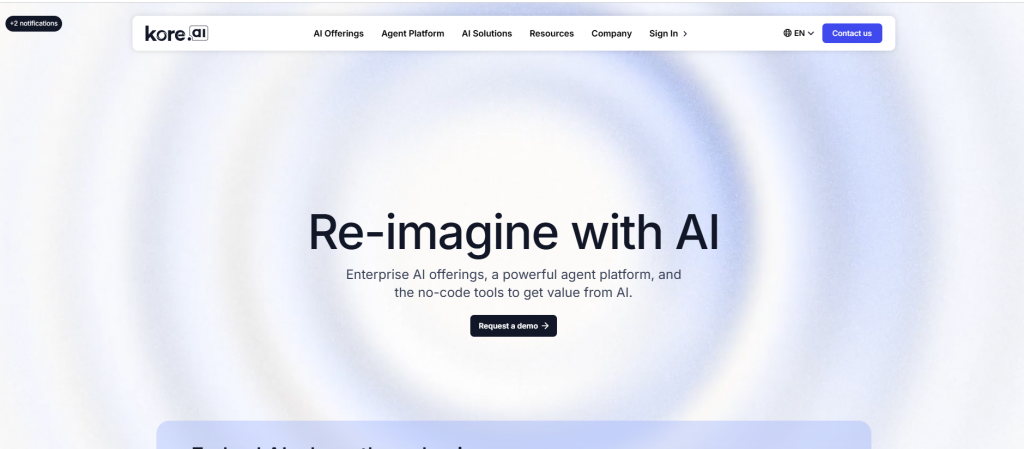
It focuses on building advanced virtual assistants that can automate complex workflows across customer service, HR, IT support, and banking operations. The platform supports both voice and chat interfaces, allowing businesses to create consistent experiences across web, mobile apps, contact centers, and messaging channels.
Kore.ai offers a robust no-code and low-code builder, enabling teams to design conversational flows, integrate APIs, and connect enterprise systems such as CRMs, ticketing tools, and internal databases. It also includes pre-built industry solutions and templates, which help enterprises accelerate deployment without starting from scratch.
For enterprise-grade requirements, the platform emphasizes security, compliance, and governance with features such as role-based access control, audit logs, and deployment flexibility across cloud and on-premise environments.
Kore.ai is best suited for large organizations that need deep customization, structured workflows, and strict control over how AI operates across multiple departments and systems.
Features
- Industry-specific templates for rapid setup.
- AI-driven voice and text assistants.
- Advanced intent recognition for workflow automation.
Pros
- Strong compliance and governance features.
- Quick launch for enterprises with standard use cases.
- Robust integration with back-end systems.
Cons
- Customization can be limited compared to open frameworks.
- Pricing may not be ideal for smaller enterprises.
Pricing
Custom pricing, typically negotiated for large deployments.
3. Ada

Ada is focused on scaling customer service for high-volume enterprises. It is built to handle large volumes of repetitive support queries, helping teams automate responses for FAQs, order tracking, account issues, and common troubleshooting without increasing headcount. The platform uses a no-code interface, allowing support teams to build, manage, and update chatbot workflows without relying on developers.
Ada integrates with existing support systems such as CRMs, helpdesks, and backend tools, enabling it to pull real-time data and deliver accurate, personalized responses. It also supports omnichannel deployment across websites, mobile apps, and messaging platforms, so businesses can maintain consistent support experiences across every touchpoint.
The platform includes features like automated conversation routing, multilingual support, and performance analytics to help teams monitor resolution rates and continuously improve responses. When automation is not enough, Ada can escalate conversations to human agents with full context, reducing friction for both customers and support teams.
Ada is best suited for enterprises that prioritize fast response times, reduced support volume, and efficient handling of high-frequency customer interactions at scale.
Features
- Automates thousands of customer topics.
- Personalized and proactive messaging.
- Support for SMS, social, and web channels.
Pros
- Designed for enterprises with high-volume support.
- Strong personalization and proactive features.
- Works across multiple digital channels.
Cons
- Limited flexibility outside customer support use cases.
- Reporting may require external tools for deeper analytics.
Pricing
Custom enterprise pricing, based on usage and integrations.
4. Yellow.ai

Yellow.ai is an AI chatbot platform supporting 100+ languages and multi-channel engagement. It is designed to help businesses manage customer conversations at scale across channels such as WhatsApp, web chat, mobile apps, email, and voice. This allows brands to deliver consistent, localized experiences for global audiences without building separate systems for each region or platform.
Yellow.ai provides a no-code and low-code builder for creating conversational workflows, enabling teams to automate use cases like customer support, lead generation, appointment booking, and feedback collection. It also integrates with CRMs, helpdesks, and backend systems to fetch real-time data and execute actions within conversations.
The platform includes AI-driven intent detection, multilingual NLP capabilities, and analytics to track performance across channels. It also supports human handoff, ensuring that complex or sensitive queries can be transferred to agents with full conversation context.
Yellow.ai is best suited for businesses that need broad language support, omnichannel presence, and scalable automation for both customer engagement and support operations.
Features
- Supports more than 135 languages.
- AI-powered chat and voice bots.
- Deep integration with enterprise systems.
Pros
- Market leader in multilingual capabilities.
- Strong focus on both customer and employee automation.
- Works well for multinational brands.
Cons
- May be more complex to deploy for smaller enterprises.
- Premium pricing for advanced global features.
Pricing
Custom pricing, tailored for enterprises with global operations.
5. Genesys
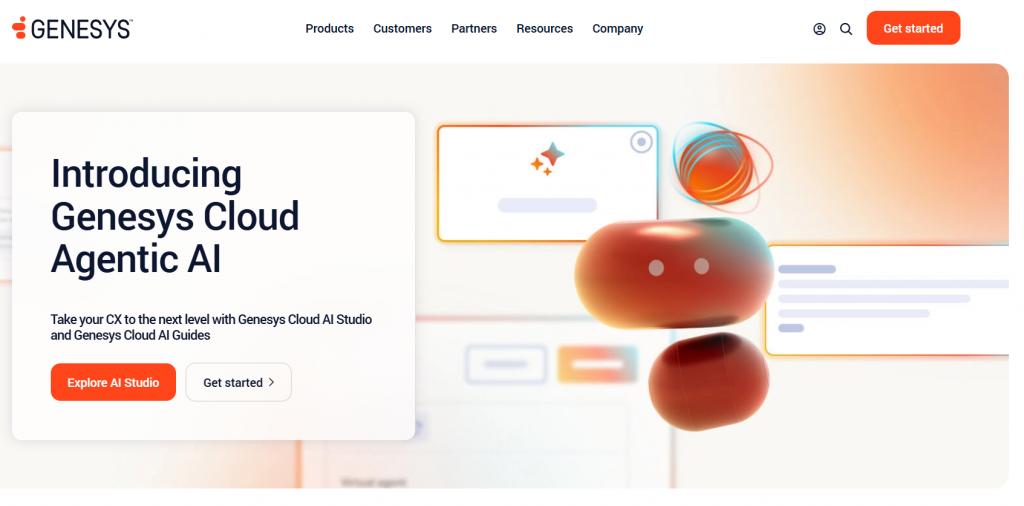
It is built to manage end-to-end customer experience across voice, chat, email, and social channels, making it a central system for large support teams and contact centers. The platform combines traditional contact center infrastructure with AI-driven tools for automation, routing, and customer insights.
Genesys offers features such as intelligent call routing, workforce management, and predictive analytics to optimize both customer interactions and agent performance. Its AI capabilities help automate routine queries, assist agents in real time, and personalize customer journeys based on behavior and history.
The platform integrates with CRMs, enterprise systems, and third-party tools, allowing businesses to unify customer data and streamline operations across departments. It also supports cloud-based deployment, giving enterprises flexibility to scale and manage global support operations efficiently.
Genesys is best suited for enterprises that need a complete contact center solution with advanced AI, deep analytics, and strong control over customer experience at scale.
Features
- Integrated with Genesys Cloud CX.
- Supports chat, messaging, and AI-driven voice.
- Customer journey orchestration with predictive routing.
Pros
- Strong fit for enterprises with complex service centers.
- AI tightly integrated with contact center workflows.
- Scales reliably for global operations.
Cons
- Can be expensive compared to standalone chatbot solutions.
- Implementation may take longer due to enterprise-scale setup.
Pricing
Subscription-based enterprise pricing via Genesys Cloud CX.
6. Salesforce Agentforce
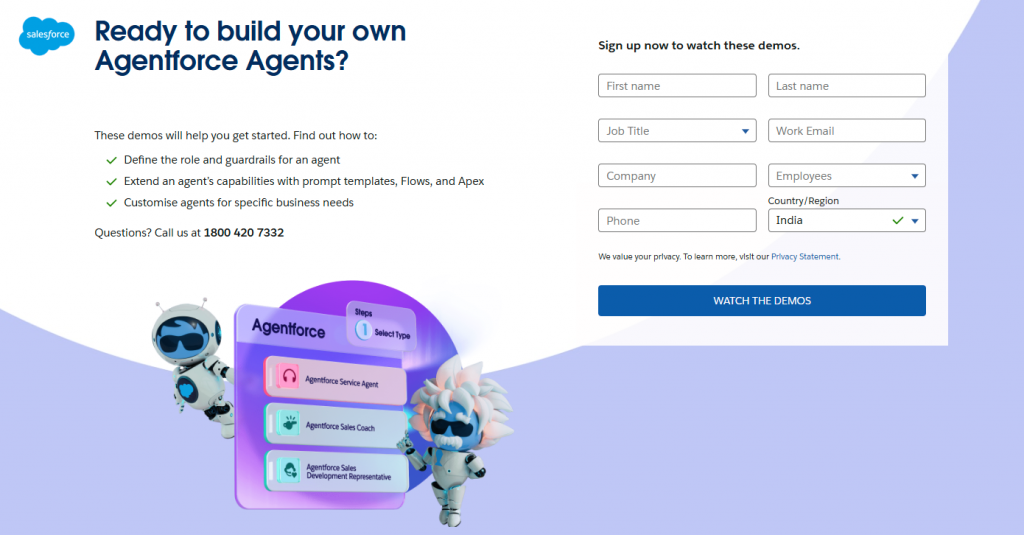
Agentforce is Salesforce’s AI-driven chatbot built directly into its CRM. It is designed to help businesses automate customer support, sales interactions, and internal workflows using real-time CRM data. Because it is natively integrated within Salesforce, it can access customer profiles, past interactions, orders, and tickets to deliver highly personalized responses without additional setup.
Agentforce enables teams to build AI agents that can qualify leads, update records, resolve support queries, and trigger workflows directly inside the Salesforce ecosystem. This reduces the need to switch between tools and ensures that every interaction is logged and aligned with existing business processes.
The platform includes low-code tools for designing conversational flows, along with AI capabilities for intent detection, response generation, and automation. It also supports human handoff, allowing agents to step in when needed with full visibility into the conversation history.
Agentforce is best suited for businesses already using Salesforce that want to extend their CRM into a unified AI-powered system for support, sales, and operations.
Features
- Automates case deflection and ticket resolution.
- Captures and qualifies leads within Salesforce.
- Industry-specific workflows pre-built into the CRM.
Pros
- Seamless integration for Salesforce users.
- Reduces agent workload by resolving simple cases.
- Enhances CRM data quality with AI-driven inputs.
Cons
- Limited appeal for enterprises not using Salesforce.
- Customization is tied closely to the Salesforce ecosystem.
Pricing
Available as an add-on for Salesforce enterprise customers.
Comparison Table: Best Enterprise Chatbots (2026)
This table compares the leading enterprise chatbot platforms of 2026, focusing on real differentiators like use cases, scalability, deployment flexibility, and best-fit industries.
| Platform | Standout Strengths | Best For | Deployment Options | Pricing Insight* |
|---|---|---|---|---|
| YourGPT | Combines support, sales, and operations in one hub with voice AI + no-code builder | Enterprises wanting a complete AI-first solution | Cloud & Hybrid | Custom enterprise plans (usage-based) |
| Kore.ai | Industry-ready assistants with banking, retail, and healthcare compliance features | Enterprises in regulated industries needing speed | Cloud, On-premise, Hybrid | Tiered enterprise contracts |
| Ada CX | Handles thousands of queries with proactive, personalized automation | Enterprises scaling customer experience at volume | Cloud SaaS | Usage-based, scales with traffic |
| Yellow.ai | 135+ languages and strong global chat + voice automation | Multinationals needing multilingual engagement | Cloud SaaS | Enterprise pricing by seats & usage |
| Genesys | Built-in contact center AI, predictive routing, and journey orchestration | Large enterprises with service-heavy operations | Cloud (Genesys Cloud CX) | Subscription, contact-center based |
| Salesforce Agentforce | CRM-native AI with lead capture, workflows, and ticket automation | Enterprises using the Salesforce ecosystem | Cloud (Salesforce CRM) | Add-on to Salesforce enterprise plans |
FAQ
What is an enterprise chatbot? ▼
An enterprise chatbot is an AI tool that helps large businesses manage customer service, sales, HR, and IT conversations at scale. It works across multiple channels and connects with internal systems like CRMs and ERPs.
How is an enterprise chatbot different from a basic chatbot? ▼
A basic chatbot usually answers simple FAQs. An enterprise chatbot can handle millions of conversations, support advanced workflows, and integrate with business tools to improve efficiency.
Can enterprise chatbots fully replace human agents? ▼
No. They automate routine tasks, but human agents are still needed for complex or sensitive requests. The best approach is using both together.
How much does an enterprise chatbot cost in 2026? ▼
Costs vary based on features and usage. Smaller plans may start in the hundreds of dollars per month. Large-scale custom setups can cost thousands.
Which industries benefit most from enterprise chatbots? ▼
Industries with high customer interaction see the most value. This includes eCommerce, healthcare, banking, telecom, travel, and HR support.
Do I need coding skills to set up an enterprise chatbot? ▼
No. Most platforms provide no-code or low-code builders. For advanced customization, technical support may be helpful.
How do chatbots improve customer satisfaction? ▼
They respond instantly, work 24/7, and personalize conversations. This reduces waiting time and creates a smoother customer experience.
Can enterprise chatbots increase sales? ▼
Yes. They recommend products, guide users through checkout, and suggest upgrades. Many businesses use them to drive conversions.
Are enterprise chatbots secure? ▼
Yes, leading providers follow strict security standards like GDPR, HIPAA, and SOC 2. Always review the vendor’s policies before choosing.
How should I choose the right enterprise chatbot? ▼
Look at scalability, integrations with your existing systems, training on your own data, and the level of vendor support. Start with a pilot project to test results before scaling.
Conclusion
Enterprise chatbots and AI agents now work together as part of a single system that supports customer service, sales, and internal operations. They handle conversations, complete tasks, and connect directly with business tools to resolve requests faster. This combination reduces manual effort and allows teams to focus on work that requires judgment and context.
Choosing the right platform comes down to practical fit. Identify one high-impact workflow where delays or volume create problems, such as support resolution, lead qualification, or internal requests. Evaluate how well the platform integrates with your systems, how reliably it completes tasks, and how easily your team can manage and improve it. Start with a focused pilot, track results such as resolution rate and time saved, then expand based on what works. Platforms such as YourGPT show how modern systems combine chatbot interactions with workflow execution in a single setup, which is often what teams need when moving beyond basic automation.
The real advantage comes from using chatbots and AI agents to remove friction from everyday operations. When your system can both communicate and act, it improves response speed, reduces costs, and delivers a consistent experience across channels. This is what helps businesses operate more efficiently and stay competitive as demands continue to grow.
Get the 2026 List of Top Enterprise Chatbot Solutions
Start building better customer care and satisfaction—no coding required. Deliver faster, more consistent support with YourGPT AI.
No credit card required • 7 days access
Leave a Reply