Live chat software now combines AI automation with human support for faster, smarter customer interactions. YourGPT stands out for its AI-first, multi-channel automation and real-time workflows. Zendesk, Intercom, and Freshdesk Messaging suit enterprises needing scale and strong analytics, while Tidio and Wati fit small businesses seeking easy, affordable chat automation.
Live chat gives customers a direct way to reach you when they need help. It cuts out delays and makes support feel immediate.
Adding AI changes the role of live chat. Instead of just connecting people to agents, the system can answer recurring questions, fetch information, and take care of routine tasks in the background. When a query needs context or empathy, the chat passes control to a person without losing history.
The result is not only faster replies. It is a smoother interaction where customers get what they came for without extra effort. Businesses benefit too: fewer repetitive tickets, more time for complex cases, and measurable improvements in satisfaction and conversion.
Choosing the right software is where the real challenge lies. Features look similar across providers, but the difference shows in how well the system fits your business whether you run a small team, an online store, a SaaS product, or a large enterprise.
This guide explains what AI live chat can deliver in 2025 and how to find a platform that matches your needs.
What Is AI Live Chat Software and How Does It Work?
AI live chat software is a support tool that uses artificial intelligence to answer customer queries in real time and connect people to live agents when needed. It reduces wait times for routine questions while making sure complex or sensitive issues still get human attention.
When a visitor opens the chat on a site or app, the AI handles the first response. It can confirm an order, explain pricing, reset a password, or give appointment details. If the request is more complex when the AI can not answer then it routes the chat to a human agent along with the conversation history so the customer does not need to repeat information.
This hybrid solution is valuable across industries. Online retailers use it to reduce repetitive tickets. SaaS companies use it to help with features understanding and setup. Banks use it to handle everyday account questions while escalating loan or investment requests to specialists. Hospitals and clinics use it to manage appointment queries and then connect patients to staff for follow-up.
Modern platforms also integrate with existing systems. They can create tickets in a helpdesk, update orders in an ecommerce platform, push status alerts from a CRM, or collect leads directly into a sales funnel. Instead of staying as surface-level bots, they become part of the workflow.
For businesses, the results are measurable. Customers get faster replies and smoother interactions. Team spend more time on valuable things rather than repeated cases. And support operations scale without any operation load.
AI live chat software is best understood as a bridge. It combines the speed and consistency of automation with the trust and judgement of human support. That balance is what makes it effective.
The 10 Support Platform at a glance
| Platform name | Best for |
|---|---|
| YourGPT | AI-first automation for support, sales, and operations |
| Zendesk Chat | Enterprise multichannel customer support |
| Intercom | SaaS onboarding and in-app customer engagement |
| Freshdesk | Affordable AI chat for SMBs |
| Drift | Sales teams focusing on lead qualification and meetings |
| Tidio | Small ecommerce stores with Lyro AI for FAQs |
| HelpCrunch | Live chat and email automation for SMBs |
| Wati | WhatsApp-first AI live chat for SMBs |
| Ada | No-code multilingual AI automation |
| LivePerson | Enterprise-scale intent-based AI for global support |
How AI Live Chat Shapes Customer Experience in 2026
Customer expectations have shifted. People want fast answers, clear guidance, and support that feels consistent at every touchpoint. AI live chat meets these expectations by removing friction from the moments that influence trust and buying decisions.
In 2026, AI is the baseline for any company that takes customer service and growth seriously. Too many businesses still treat it as a simple chatbot. That mistake costs revenue and damages trust. Here is where it actually delivers value:
- Instant Responses
Support tickets have doubled across industries as more transactions move online. AI chat absorbs the repeat questions so your team is not buried under password resets, refund requests, or booking confirmations. - Coverage across regions
Customers do not wait for business hours. A buyer in New York and a student in Singapore both expect help on their schedule. AI fills those gaps without overnight staffing costs. - Accuracy that scales
Human agents vary. Some are new, some misinterpret, some improvise. AI keeps answers aligned with your knowledge base, policies, and compliance rules so mistakes do not multiply as you grow. - Support that drives revenue
A conversation is no longer just “solving a ticket.” With live chat tied you have the opportunity to upsell, cross sells, or capture a lead on the spot. - Adaptation to change
Product details, prices, or policies can change monthly. Static FAQs go stale. AI live chat updates with your live data so the information is always current.
The companies winning in 2025 are the ones that stop thinking of live chat as customer support software and start treating it as a growth engine.
8 Best AI and Live Chat Support Software
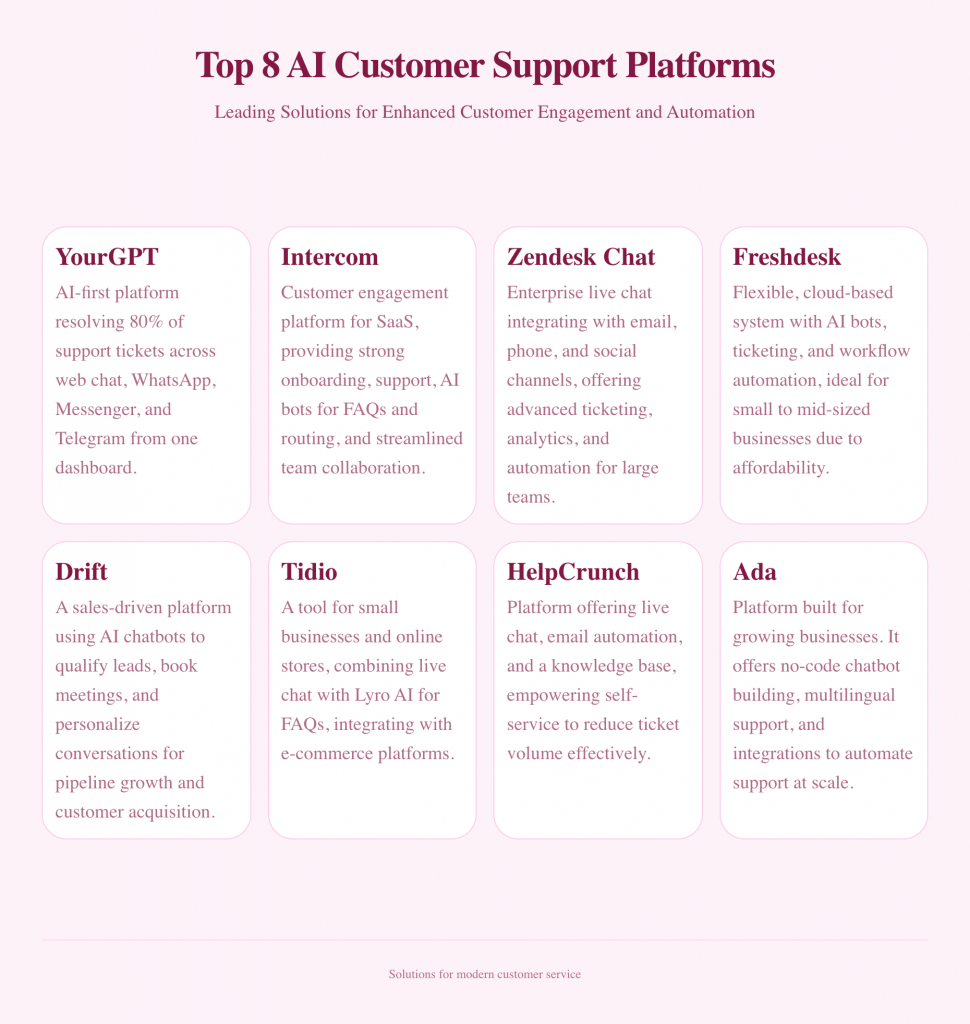
Customer expectations in online business have moved toward instant replies, personalized interactions, and support that never goes offline. Modern platforms meet these demands by pairing AI automation with human agents through live chat. This combination shortens wait times, boosts conversions, and helps teams handle higher volumes without losing quality.
Below is the section that highlights the 8 leading tools for different category.
1. YourGPT: An AI-first platform that resolves 80% of support tickets without human intervention. It trains on your actual product docs, and works across web chat, WhatsApp, Messenger, and Telegram from one dashboard.
2. Intercom: A customer engagement platform with strong onboarding and support features for SaaS. Its AI bots handle FAQs and routing, while its workflows and team inbox streamline agent collaboration.
3. Zendesk Chat: Enterprise-ready live chat software that integrates with email, phone, and social channels. It provides advanced ticketing, analytics, and automation to help large teams manage customer conversations at scale.
4. Freshdesk Messaging: A flexible, cloud-based system with AI bots, ticketing, and workflow automation. Its affordability and ease of use make it a strong choice for small to mid-sized businesses.
4. Drift: A sales-driven platform that uses AI chatbots to qualify leads, book meetings, and personalize conversations. It is ideal for companies focused on pipeline growth and customer acquisition.
5. Tidio: A lightweight tool designed for small businesses and online stores. It combines live chat with Lyro AI for FAQs and integrates with Shopify, WordPress, and WooCommerce.
6. HelpCrunch: A hybrid communication platform that offers live chat, email automation, and a knowledge base. It helps brands reduce ticket volume by empowering customers with self-service options.
8. Ada: An AI customer service platform built for growing businesses. It offers no-code chatbot building, multilingual support, and integrations to automate support at scale.
Best AI Live Chat Software in 2026
Choosing the right AI live chat tool can directly shape customer experience, reduce operational costs, and increase sales. Below are the top platforms helping online businesses deliver faster, smarter, and more personalized support.
1. YourGPT

YourGPT is an AI-first platform that combines customer support, sales, and operations in one solution. It offers a no-code chatbot builder, advanced AI training on custom data, and omnichannel deployment across web, WhatsApp, Messenger, Telegram, and more.
With its automation-first approach, YourGPT helps businesses handle order queries, reduce cart abandonment, and streamline post-purchase workflows while scaling to enterprise needs.
Features
- No-code bot builder for quick setup
- Custom training on PDFs, websites, Notion, Google Sheets, and product catalogs
- Omnichannel support across web, WhatsApp, Messenger, Telegram, and LINE
- Voice-enabled interactions for mobile and web
- Unified inbox with live agent handoff
- Workflow automation for support, sales, and operations
Pros
- Covers support, sales, and ecommerce in one platform
- Easy no-code setup with flexible AI training
- Scales from small stores to enterprises
- Supports both text and voice AI
- Integrates with ecommerce platforms and team tools
Cons
- Advanced customizations may require technical support
- Free plan has limited access to premium features
2. Zendesk Chat
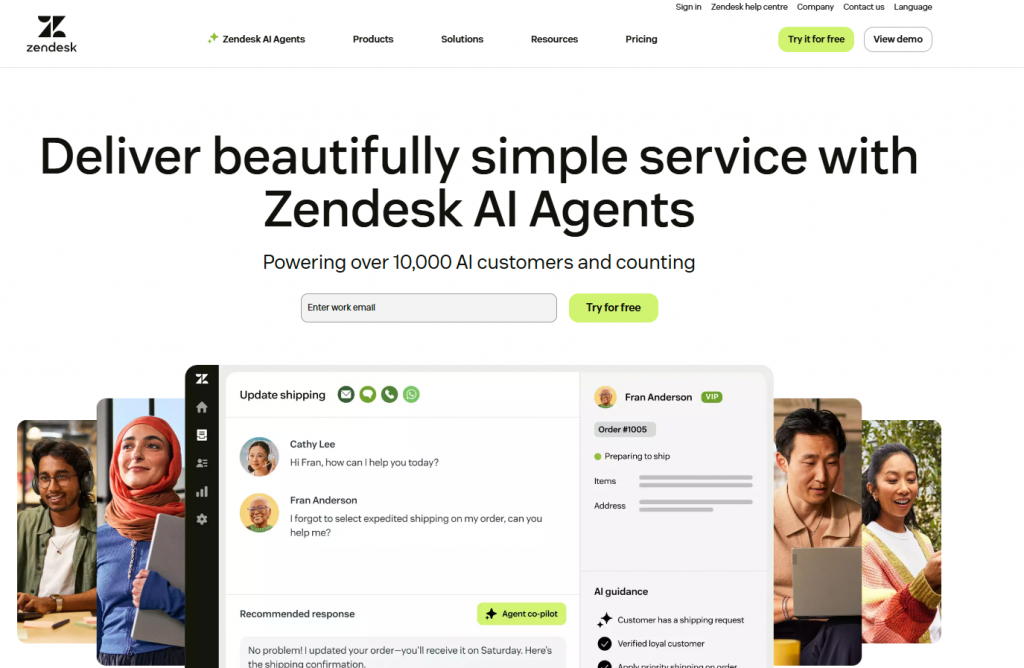
Zendesk Chat is built for enterprises that need a scalable hub to manage customer conversations across email, chat, phone, and social channels. It comes with advanced ticketing, automation, and analytics to streamline support for large teams.
Features
- Centralized dashboard for multichannel support
- Automated ticketing and routing
- Advanced analytics and reporting
- Workflow automation and macros
- Agent performance tracking
Pros
- Ideal for enterprise-level support
- Strong automation and workflow tools
- Deep reporting for decision-making
- Integrates with a wide range of apps and CRMs
Cons
- Can feel complex for smaller teams
- Higher pricing compared to SMB-focused tools
3. Freshdesk Messaging
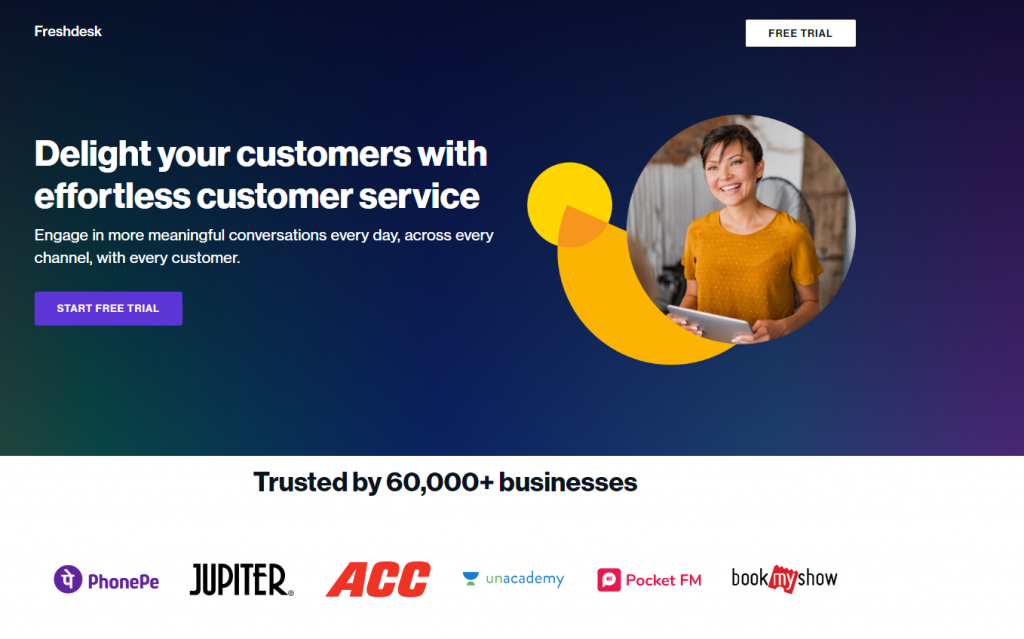
Freshdesk Messaging is a growth-friendly tool designed for small and mid-sized businesses. It includes AI bots, intuitive ticketing, and workflow automation to simplify support while keeping costs low.
Features
- AI bots for common queries
- Integrated ticketing system
- Multi-channel support (chat, email, phone)
- Self-service knowledge base
- Customizable workflows
Pros
- Affordable and flexible plans
- Simple setup for SMBs
- AI bots reduce repetitive tasks
- Scales as businesses grow
Cons
- Limited advanced features on entry plans
- Some customization may require add-ons
4. Drift

Drift is designed for sales-driven teams. Its AI bots qualify leads, book meetings, and personalize conversations, making it a popular choice for companies focused on growth and customer acquisition.
Features
- AI-powered lead qualification
- Meeting scheduling directly from chat
- Proactive messaging for engagement
- CRM and marketing automation integration
- Conversation insights
Pros
- Strong focus on lead generation
- Speeds up pipeline creation
- Proactive messaging boosts engagement
- Works well with sales CRMs
Cons
- Best suited for sales-heavy organizations
- Pricing may be high for smaller teams
5. Tidio

Tidio is a lightweight AI live chat solution designed for small businesses and online stores. It combines live chat with Lyro AI to answer FAQs and integrates with ecommerce platforms like Shopify and WooCommerce.
Features
- Live chat widget with customizable design
- Lyro AI for FAQ handling
- Integrations with Shopify, WooCommerce, and WordPress
- Shared inbox for multichannel communication
- Pre-built chatbot templates
Pros
- Easy to use for beginners
- Affordable pricing for SMBs
- Ecommerce-friendly integrations
- AI assistant reduces manual workload
Cons
- Limited features in free version
- Advanced AI tools may require higher plans
6. HelpCrunch
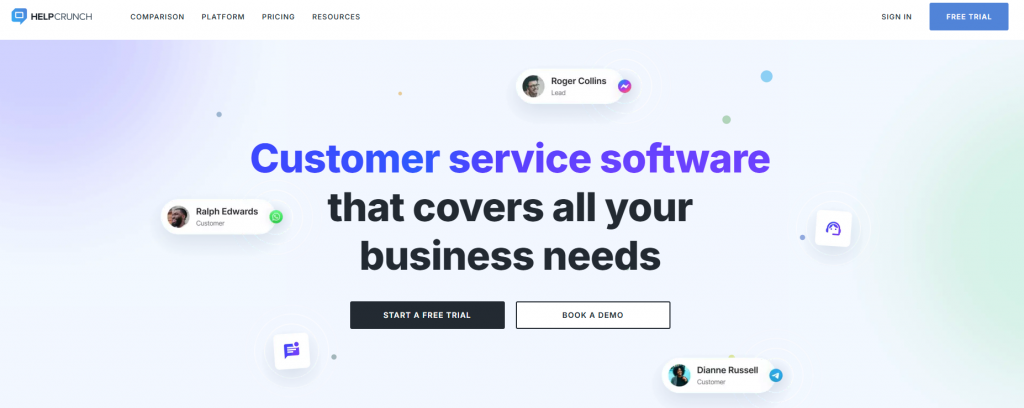
HelpCrunch combines live chat, email automation, and a knowledge base into one platform. It’s designed to reduce ticket volume by giving customers access to self-service resources alongside live chat.
Features
- Live chat with proactive messaging
- Built-in knowledge base
- Email automation for follow-ups
- Multi-channel support in one dashboard
- Customer segmentation tools
Pros
- Combines live chat and email in one platform
- Knowledge base reduces tickets
- Affordable for SMBs
- Easy to set up and manage
Cons
- Fewer advanced enterprise features
- Smaller integration ecosystem compared to larger platforms
7. Intercom
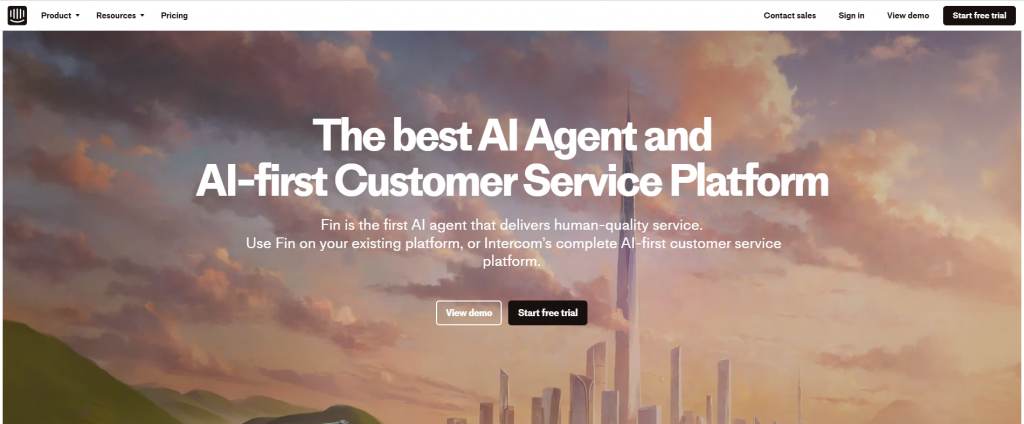
Intercom is a customer engagement platform widely used by SaaS companies. Its AI bots handle FAQs and routing, while workflows and team inbox features streamline agent collaboration.
Features
- AI bots for automated responses
- Shared team inbox with collaboration tools
- Customizable workflows for customer journeys
- In-app messaging for SaaS products
- Detailed customer profiles
Pros
- Strong for SaaS onboarding and support
- Flexible workflows
- Powerful in-app messaging
- Good for scaling SaaS companies
Cons
- Can be expensive as you scale
- Learning curve for setup and customization
8. Wati
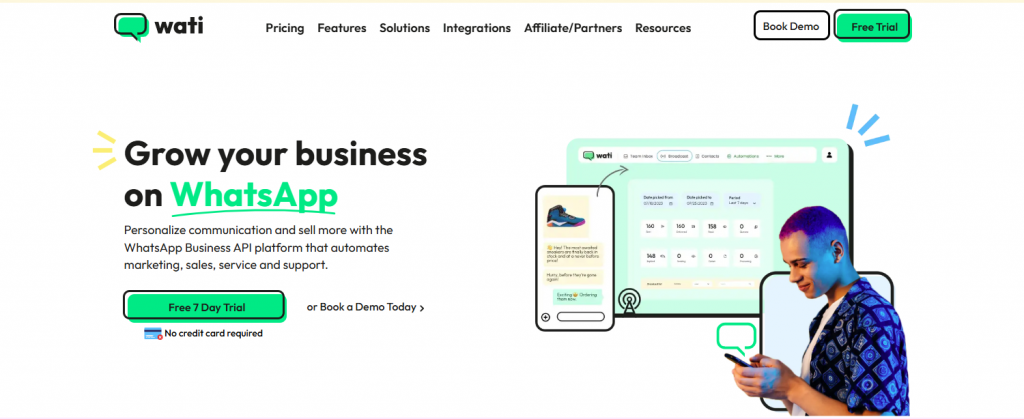
Wati is a WhatsApp first solution built on the official Business API. It enables customer flows, automated reminders. It is not a full live chat solution.
Features
- AI chatbots within WhatsApp
- Proactive reminders and notifications
- Multi-agent support
- No-code flow builder
- Official WhatsApp Business API integration
Pros
- Specialized for WhatsApp support
- Affordable for small to mid-sized teams
- Automates reminders and order updates
- Easy setup with pre-built flows
Cons
- Limited outside WhatsApp
- May not suit businesses needing multichannel coverage
9. Ada

Ada is an AI-powered customer service platform built for businesses that want scalable automation. It goes beyond FAQs by supporting personalized conversations and advanced integrations.
Features
- No-code chatbot builder
- Multilingual support
- CRM and helpdesk integrations
- Omnichannel deployment (web, social, messaging apps)
- Advanced analytics
Pros
- Handles both FAQs and complex queries
- Scales for mid-sized and enterprise teams
- Strong integration options
- Easy to update without coding
Cons
- Higher cost compared to lightweight tools
- May feel advanced for very small businesses
10. LivePerson
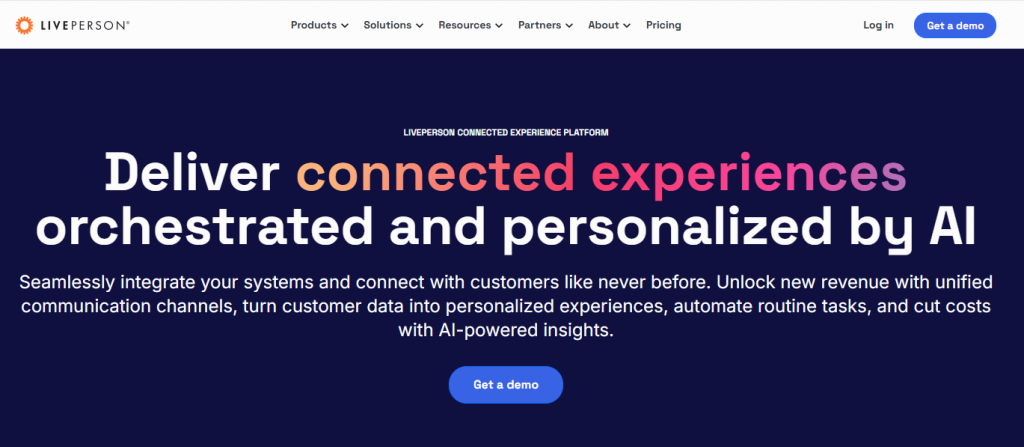
LivePerson is an enterprise-grade solution built for high volumes and complex customer journeys. Its AI predicts intent, automates repetitive tasks, and scales for global support teams.
Features
- AI-powered intent recognition
- Multi-channel messaging
- Proactive engagement tools
- Advanced analytics and reporting
- Enterprise-level compliance and security
Pros
- Strong enterprise features
- Scales to global operations
- Predictive AI enhances personalization
- Deep analytics for performance tracking
Cons
- Complex to set up for smaller teams
- Pricing targeted toward large enterprises
Feature comparison table
| Platform | Best For | No-Code Builder | AI Training on Custom Data | Self-Learning | Voice AI | CRM / Helpdesk Integration | Multi-Channel Support | Knowledge Base | Lead Capture | Security & Compliance |
|---|---|---|---|---|---|---|---|---|---|---|
| YourGPT | AI-first automation for support, sales, and operations | ✓ | ✓ (PDFs, Websites, Notion, Google Sheets) | ✓ | ✓ (Voice & Multimodal) | ✓ (CRM, Ecommerce, Slack, Email) | Web, WhatsApp, Messenger, Telegram, LINE | ✓ | ✓ (AI lead forms & workflows) | SOC 2, GDPR, HIPAA-ready |
| Zendesk Chat | Enterprise teams managing large-scale customer conversations | ✗ | Limited (via knowledge base) | ✓ | ✗ | ✓ (Email, Phone, Social) | Web, Social, Mobile | ✓ | ✓ | GDPR, SOC 2 |
| Freshdesk Messaging | SMBs needing affordable AI chat and workflow automation | ✓ | Limited | ✗ | ✗ | ✓ (CRM, Ticketing) | Web, Email, Phone | ✓ | ✓ | Standard |
| Drift | Sales-driven teams focusing on lead generation | ✓ | ✗ | ✗ | ✗ | ✓ (CRM & Marketing Platforms) | Web, Email | ✗ | ✓ (Proactive chat & scheduling) | Standard |
| Tidio | Small online stores and ecommerce support teams | ✓ | ✗ | ✗ | ✗ | ✓ (Shopify, WooCommerce, WordPress) | Web, Messenger, Instagram | ✗ | ✓ | Standard |
| HelpCrunch | SMBs combining live chat, email, and self-service | ✓ | ✗ | ✗ | ✗ | ✓ (Email & CRM) | Web, Email | ✓ | ✓ | Standard |
| Intercom | SaaS companies managing onboarding and support | Limited | ✓ | ✓ (Fin AI) | ✓ (Beta) | ✓ (CRM & App Store) | Web, Email, Mobile | ✓ | ✓ | GDPR, SOC 2 |
| Wati | WhatsApp-first communication for small businesses | ✓ | ✗ | ✗ | ✗ | Limited | WhatsApp, Email | ✗ | ✓ | Standard |
| Ada | Mid-sized to enterprise automation with multilingual support | ✓ | ✓ | ✓ | ✗ | ✓ (CRM, Helpdesk) | Web, Social, Messaging Apps | ✓ | ✓ | GDPR |
| LivePerson | Global enterprises with complex support journeys | Limited | ✓ (AI knowledge integration) | ✓ | ✗ | ✓ (Enterprise CRMs) | Web, Voice, Mobile, Social | ✓ | ✓ | Enterprise grade |
How to Choose the Right AI Live Chat Software for Your Business
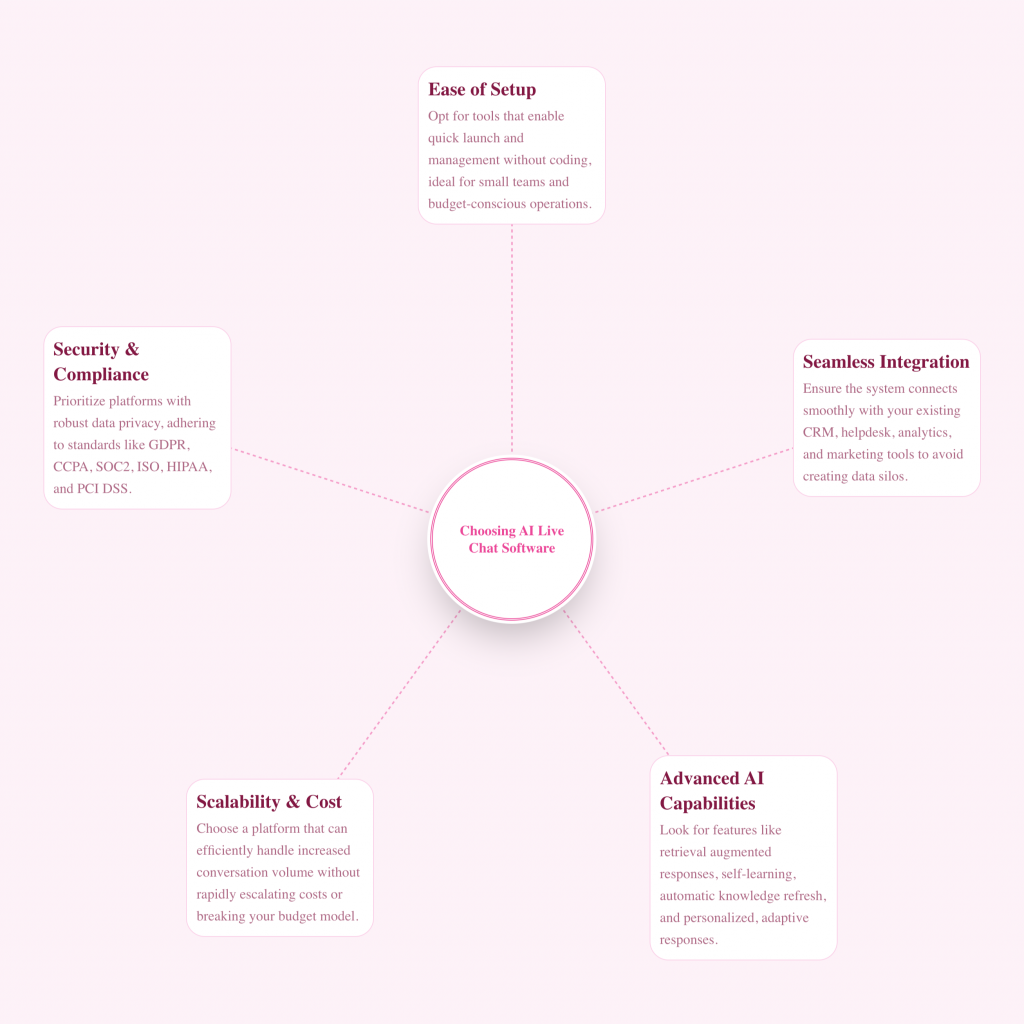
The best AI live chat platform is the one that fits how your business actually runs. Teams want faster replies, lower workloads, clear pricing, and a system that doesn’t disrupt existing workflows. These factors will help you identify what truly supports your goals.
- Ease of setup
If your team is small or requirement is urgent, long configurations slow everything down. Pick a platform your staff can launch in hours, not weeks. It should allow updates without coding and keep monthly costs predictable. - Integration with your stack
Your chat system should work with the tools your team already depends on. Smooth integration with CRM, helpdesk, analytics, and marketing systems means conversations, data, and workflows stay connected. Without this, the tool creates extra steps instead of removing them. - AI capabilities
Modern platforms should include retrieval augmented responses, self-learning from new interactions, and the ability to refresh knowledge automatically. Look for tools that can adapt to your data, personalize responses, and improve accuracy over time instead of staying static. - Scalability
Check how the platform performs as conversation volume rises. Some tools become expensive quickly. Choose one that scales usage without breaking your cost model. - Security and compliance
Data privacy is non-negotiable. Look for the platform compliance like CCPA, GDPR and industry standards like SOC2, HIPAA or PCI DSS.
Future Trends in AI Live Chat
AI live chat is moving from reactive bots to autonomous support layers that sit at the core of business operations. Several technical shifts are driving this change:
1. Agents That Execute (Not Only Respond)
AI models are now paired with orchestration frameworks that can call APIs, trigger workflows, and handle secure transactions. Instead of answering “How do I get a refund,” the AI can process the refund, update the CRM, and send a confirmation, Completing all the steps without any human input.
2. Convergence of Voice and Chat
The line between chat and voice is disappearing. Real-time ASR (automatic speech recognition) and low-latency TTS (text-to-speech) allow customers to switch channels mid-conversation without losing context. A session started on a website chat widget can move to a phone call or smart speaker, with the AI carrying state across channels.
3. Self-Learning Systems
AI learns retrain on unresolved queries, missed intents, and conversation logs. This creates a system that improves accuracy week by week instead of relying on manual updates.
4. Proactive and Predictive Support
AI will not wait for the user to click “Chat.” By analysing session patterns, drop-offs, and behavioural signals, it can initiate timely interventions — guiding a SaaS user stuck in onboarding or nudging an ecommerce buyer at risk of abandoning checkout.
5. Multi-Agent Architectures
Instead of a single bot handling every task, future live chat will rely on multiple specialised agents. A customer-facing agent manages conversation, a business agent executes workflows, another enforces compliance rules, sale agent finds the opportunity to up-cross sell and a validator agent checks knowledge. An orchestration layer coordinates them, ensuring both accuracy and accountability.
These trends signal a clear direction: AI live chat is no longer a customer service add-on. It is becoming an intelligent support infrastructure that reduces human workload, protects accuracy, and directly drives business outcomes.
FAQ
What is AI live chat software? ▼
AI live chat software combines intelligent chatbots with human agents. The AI handles common questions instantly, while human agents step in for more complex or sensitive conversations.
How is it different from a regular chatbot? ▼
Unlike regular chatbots that follow fixed scripts, AI live chat tools understand user intent, learn from past interactions, and perform actions like booking appointments or checking order status.
Can small businesses use AI live chat? ▼
Yes, AI live chat is accessible to small businesses. Many platforms offer affordable or even free plans that allow small teams to provide 24/7 customer support efficiently.
How does it help e-commerce businesses? ▼
AI live chat can check order status, recover abandoned carts, recommend products, and answer customer questions—helping boost sales and build loyalty.
What about SaaS companies? ▼
For SaaS businesses, AI live chat helps onboard users, resolve technical questions, and route support tickets to the right teams—improving customer success and reducing churn.
Is customer data safe with AI live chat? ▼
Yes. Trusted platforms use encryption and follow data privacy regulations like GDPR to ensure customer data remains protected and secure.
Does it connect with CRMs and other tools? ▼
Yes, most AI chat platforms integrate with CRMs, helpdesks, and e-commerce systems, keeping customer data and conversations unified in one place.
Will AI replace human agents? ▼
No. AI supports agents by handling repetitive tasks, but human agents are still essential for complex issues and emotional intelligence.
How long does setup take? ▼
Basic AI live chat setup usually takes just a few hours. Advanced integrations and custom workflows may take longer, depending on your needs.
What trends are shaping AI live chat? ▼
Key trends include task-completing AI, unified voice and chat experiences, hyper-personalized responses, proactive outreach, and support for multiple languages.
Conclusion
AI live chat is now essential. Customers in 2026 expect quick, accurate, and personal responses. Businesses that meet this expectation earn trust and loyalty, while those that don’t fall behind.
The right platform depends on your needs. Small teams want easy setup, retailers need ecommerce integrations, SaaS companies rely on onboarding and syncing, and enterprises need scale and compliance.
The best results come when AI handles routine tasks and humans focus on empathy and complex issues.
YourGPT follows this balance. It is AI-first, human-guided, and self-learning, built to manage support, sales, and operations across text, voice, and visual channels, helping teams deliver faster and more personal communication at every stage.
Find the Right AI Live Chat Tool for Your Business
Give your customers instant answers, personal support, and around-the-clock availability with the right AI live chat tools.
No credit card required • Quick setup • Integrates with CRMs
Leave a Reply