TL;DR
Maven AGI works for enterprise automation but many teams need simpler setup and clearer pricing. This guide reviews 10 proven alternatives for 2026 including YourGPT AI for no-code deployment, Intercom for SaaS engagement, Gorgias for ecommerce, and Zendesk for enterprise operations. Each platform covers specific use cases from customer support to IT automation.
Maven AGI is a capable AI platform, but it is not always the best fit for every team. Many businesses in 2026 want simpler setup, clearer pricing, stronger no-code options, and deeper multichannel support.
From customer support and sales to internal automation and ecommerce, there are tools that fit specific needs better. Some work well for small teams, others scale to enterprise. This guide breaks down the 10 best Maven AGI alternatives so you can choose the one that helps you work smarter.
Why Businesses Are Exploring Maven AGI Alternatives
Maven AGI offers intelligent customer support automation, but several practical challenges make teams consider other platforms. Based on user feedback and market analysis, here are the main reasons businesses explore alternatives:
1. Automation reliability
Users have reported that Maven AGI looks good in demo, but real support conversations still require supervision. When queries contain layered intent or sensitive context, the agent often needs human correction. This reduces the benefit of “fully autonomous support” that the product positions heavily.
2. The platform’s structure is tightly centred on support tickets
The system is designed around support flows such as triage, categorisation, and resolution. When teams try to automate functions outside support—such as operational actions, account changes, fulfilment steps, or internal approvals—the platform reaches its structural limits. This restricts its use as an all-purpose automation layer.
3. Complex workflows
Basic flows can be created in the interface, but deeper logic such as conditional branches, multi-step transactions, backend updates, and API-driven actions require technical setup. This creates dependency on developers and slows iteration for teams that want self-serve automation.
4. Stability issues
The platform undergoes frequent backend adjustments. Naming structures, reporting sections, and some internal behaviours shift over time. These changes interrupt existing processes and force teams to re-learn or re-configure parts of their setup.
5. Limited Customisation
Maven AGI offers a fixed workflow structure that works for general support tasks but becomes restrictive when a business needs detailed industry logic. Sectors such as finance, healthcare, insurance, logistics, and travel often require multi-step checks, verification rules, audit trails, or policy-driven actions.
These processes cannot be modelled natively in the platform and need extensive manual configuration. This makes it difficult to deploy Maven AGI in environments where precision and strict procedural control are necessary.
10 Best Maven AGI Alternatives: Complete Comparison (2026)
Finding the right customer support platform requires understanding how each option fits your specific needs. We’ve compiled a comprehensive review of the 10 best Maven AGI alternatives for 2026. Each platform review covers core capabilities, limitations, and ideal use cases to help you make an informed decision.
1. YourGPT AI
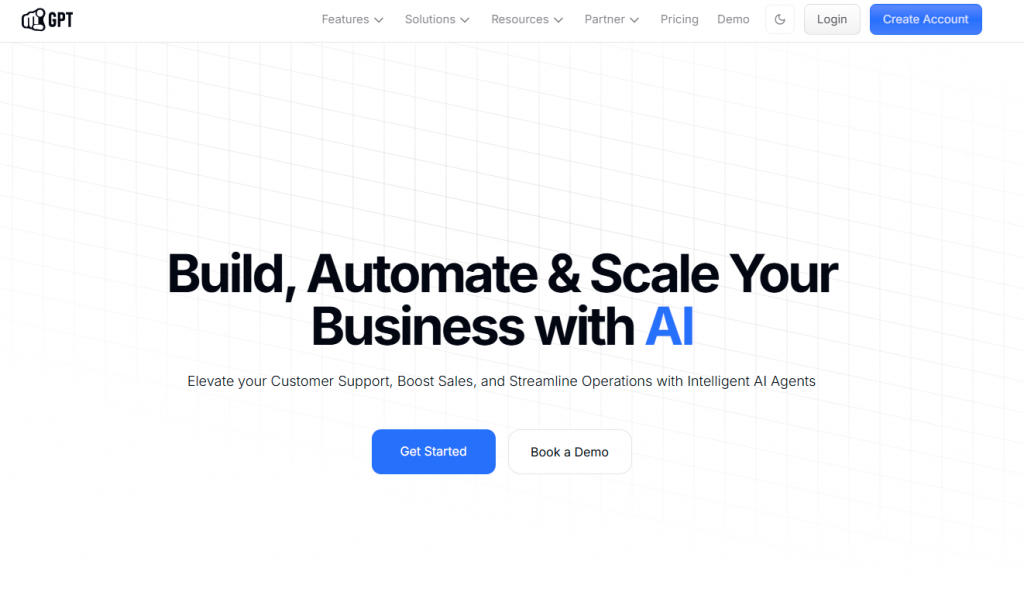
YourGPT AI is an AI-first platform designed to build and deploy conversational AI agents without coding. It helps businesses manage customer support, sales, and operations through a single workspace that connects to websites, WhatsApp, Slack, Messenger, Instagram, LINE, email, and voice channels. With advanced AI, self-learning capabilities, and visual automation tools, YourGPT enables teams of any size to automate conversations, cut repetitive tasks, and deliver faster, more personalized experiences at scale.
Features:
- No-Code Builder: Create and launch intelligent chatbots from documents, FAQs, or website links using a visual builder with drag-and-drop interface.
- Custom Knowledge Bases: Train your chatbot on your own business data to deliver context-aware and precise responses that match your brand tone.
- Multilingual Support: Communicate with customers in over 100 languages for consistent global audience support.
- Omnichannel Integration: Deploy across WhatsApp, Messenger, Instagram, LINE, Slack, Telegram, and websites from a single platform.
- Voice Agents: Add AI-powered voice and phone interactions for natural customer conversations.
- Lead Generation Tools: Capture and qualify leads with automated workflows, forms, and smart routing.
- AI Helpdesk Integration: Enable self-service support with smooth handoff to human agents when needed.
- Analytics Dashboard: Track conversation metrics, user behavior, and bot performance in real time.
Limitations:
- Trial Limitations: The free version includes essential features, while advanced automation tools are part of paid plans.
- Quick Product Iteration: Frequent updates mean some new features may evolve or change based on user feedback.
Best For:
- Support Teams: Scaling customer support without increasing headcount.
- Sales Teams: Automating lead qualification and follow-up processes.
- Operations & IT: Managing internal workflows and task automation.
- Agencies: Running multiple client chatbots with flexible control.
2. Intercom
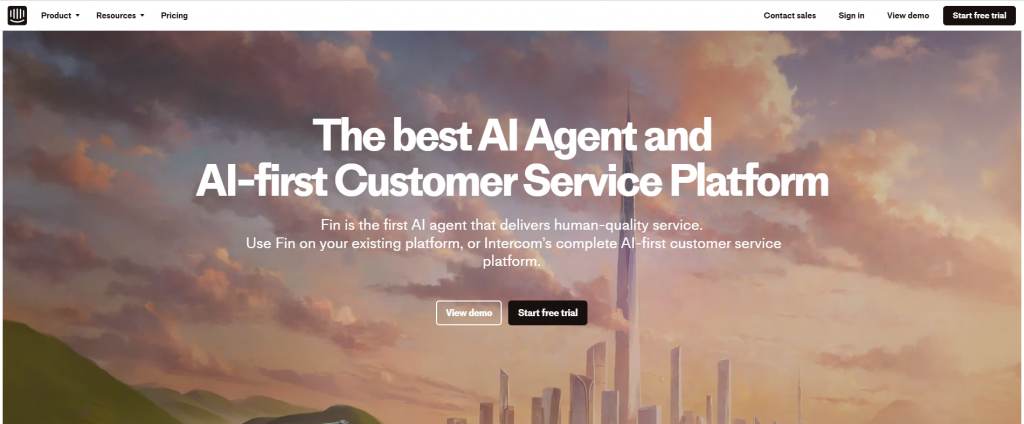
Intercom is a well-established customer communication and engagement platform that combines live chat, AI chatbots, and automation tools. It helps businesses manage conversations, onboard new users, and provide support across web and mobile applications. Known for its polished design and strong customer data tools, Intercom is often used by SaaS companies and growing startups to improve engagement and retention.
Features:
- AI-Powered Chatbots: Automate responses to common questions and route conversations intelligently.
- Live Chat: Communicate with visitors and customers in real time on websites and apps.
- Shared Inbox: Centralize support requests and messages from multiple channels.
- Product Tours: Guide users through onboarding or feature adoption with in-app walkthroughs.
- Customer Data Platform: Store and use customer information for personalized communication.
- Integration Library: Connect with tools such as Salesforce, HubSpot, and Slack for workflow automation.
Limitations:
- High Pricing: Costs increase as conversation volume and feature usage grow.
- Technical Setup: Some advanced workflows require configuration and developer assistance.
Best For:
- SaaS Companies: Managing customer onboarding and product engagement.
- Support Teams: Handling multi-channel customer communication efficiently.
- Startups and SMBs: Businesses looking for polished chat and CRM-style engagement tools.
3. Leena.ai
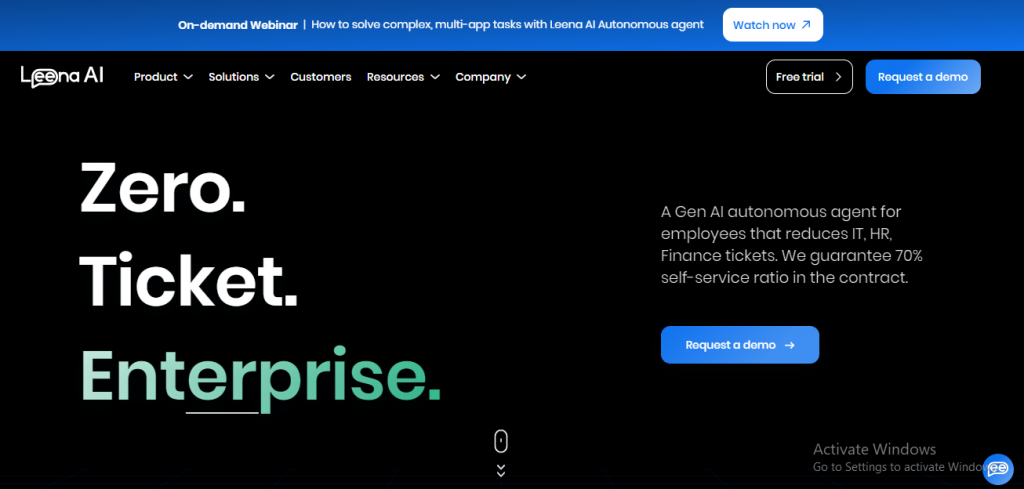
Leena.ai is an employee experience platform that uses conversational AI to automate internal support, HR queries, and IT helpdesk functions. It helps organizations improve employee satisfaction by providing instant, accurate answers to common workplace questions through chat interfaces. The platform integrates with existing HR systems and knowledge bases to deliver personalized employee support at scale.
Features:
- Employee Service Automation: Handle HR, IT, and administrative queries automatically with AI-powered virtual assistants.
- Knowledge Base Integration: Connect with existing documentation, wikis, and internal resources for accurate answers.
- Multi-Language Support: Assist global workforces in their preferred languages across all regions.
- Workflow Automation: Automate leave requests, ticket creation, approval processes, and policy inquiries.
- Analytics Dashboard: Track employee engagement, query resolution times, and Customer satisfaction metrics in real time.
- HRIS Integration: Connect seamlessly with Workday, SAP SuccessFactors, Oracle HCM, and other HR platforms.
Limitations:
- Internal Focus: Designed primarily for employee experience, not suitable for customer-facing use cases.
- Enterprise Pricing: Cost structure better suited for mid-size to large organizations with significant employee bases.
Best For:
- HR Teams: Automating employee queries and reducing support ticket volume across global organizations.
- IT Departments: Providing instant helpdesk support for common technical issues and onboarding.
- Large Enterprises: Organizations with distributed workforces needing centralized, consistent employee support.
4. Ada
Ada is an AI-powered automation platform designed to help businesses deliver efficient, personalized customer support across chat, social, and voice channels. It focuses on reducing manual workload by automating repetitive queries and integrating smoothly with existing helpdesk and CRM systems.
Features:
- No-Code Builder: Create automated conversations through an easy drag-and-drop interface without technical expertise.
- AI-Powered Automation: Understands user intent and delivers relevant, contextual responses using advanced NLU.
- Omnichannel Deployment: Works seamlessly across web, WhatsApp, Facebook Messenger, Instagram, and SMS channels.
- CRM and Helpdesk Integrations: Connects directly with Zendesk, Salesforce, Freshdesk, HubSpot, and Shopify.
- Multilingual Support: Handles global audiences with support for over 100 languages and automatic translation.
- Analytics Dashboard: Tracks deflection rates, response times, CSAT scores, and customer satisfaction metrics.
Limitations:
- Enterprise Pricing: Higher cost structure suited primarily for mid-market and enterprise clients with volume needs.
- Customization Scope: Advanced personalization and complex workflows may require additional setup and API access.
Best For:
- Enterprises: Businesses managing high-volume customer interactions across multiple channels and time zones.
- Support Teams: Organizations seeking to reduce response time, automate FAQs, and improve ticket deflection.
- Ecommerce and SaaS Companies: Brands aiming to deliver consistent, scalable customer experiences globally.
5. Yellow.ai

Yellow.ai is an enterprise-grade conversational AI platform that combines intelligent automation with advanced natural language understanding to manage complex customer interactions across chat and voice channels. It enables global businesses to automate customer journeys, improve service delivery, and handle high-volume conversations efficiently.
Features:
- Omnichannel Bots: Deploy intelligent chat and voice assistants across web, mobile, WhatsApp, and 35+ channels.
- Advanced NLU: Supports human-like contextual understanding in over 135 languages with dialect support.
- Bot Orchestration: Automate complex, multi-step workflows across customer service, sales, and operations departments.
- Enterprise Integrations: Offers ready connectors for CRM, ERP, HRMS, and 100+ enterprise tools for seamless data flow.
- Voice AI: Provides natural voice interaction, IVR capabilities, and automated call center operations.
- Analytics Platform: Delivers real-time insights into customer engagement, bot performance, and conversation quality.
Limitations:
- Enterprise Focus: Platform complexity and pricing may be excessive for small and medium-sized businesses.
- Implementation Time: Requires technical expertise and longer deployment cycles for full customization and integration.
Best For:
- Large Enterprises: Companies operating across multiple regions, departments, and customer touchpoints at scale.
- Global Brands: Organizations offering multilingual support in diverse markets with complex compliance needs.
- Corporate Teams: IT, HR, and customer service departments managing large-scale automation and high volumes.
6. Devrev.ai
Devrev.ai is a modern customer support platform built specifically for product-led companies. It connects customer conversations directly to product development, engineering workflows, and revenue operations. The platform helps technical teams manage support tickets while maintaining visibility into product issues and customer feedback loops.
Features:
- Product-Led Support: Links customer issues directly to product roadmaps, engineering tasks, and feature development.
- Unified Workspace: Combines support tickets, product feedback, bug reports, and developer workflows in one platform.
- AI-Powered Triage: Automatically categorizes, prioritizes, and routes tickets based on content, urgency, and context.
- Engineering Integration: Connects seamlessly with GitHub, Jira, Linear, and development tools for faster resolution.
- Customer Timeline: Shows complete interaction history across support, product usage, and sales touchpoints.
- Analytics for Product Teams: Tracks feature requests, bug trends, customer sentiment, and product impact metrics.
Limitations:
- Product Team Focus: Best suited for tech companies with active product development cycles and engineering resources.
- Learning Curve: Requires alignment and coordination between support, product, and engineering teams for effectiveness.
Best For:
- SaaS Companies: Product-driven organizations connecting customer support directly to engineering and development.
- Technical Support Teams: Teams managing complex product issues, bugs, and feature requests efficiently.
- Startups and Scale-ups: Fast-growing companies needing integrated customer-product workflows and tight feedback loops.
7. Zendesk
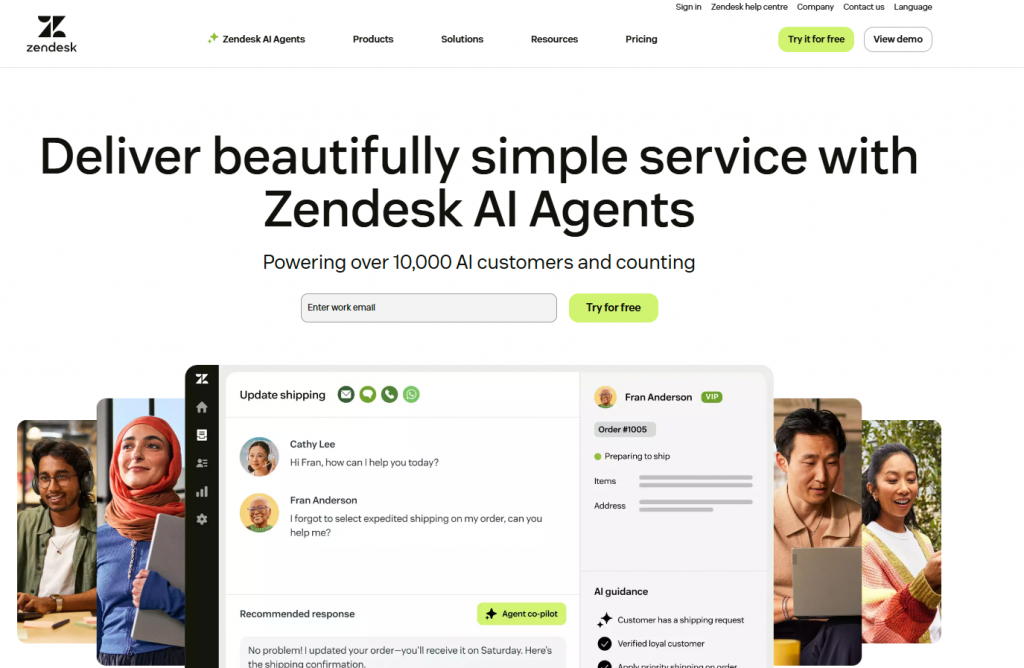
Zendesk is a leading enterprise customer service platform that provides ticketing, live chat, knowledge management, and omnichannel support tools. Known for its scalability and extensive integration ecosystem, Zendesk helps large organizations manage complex support operations across email, chat, voice, and social channels.
Features:
- Ticketing System: Manage, prioritize, track, and resolve customer issues efficiently across all channels.
- Omnichannel Support: Handle interactions seamlessly across email, chat, phone, social media, and messaging apps.
- Knowledge Base: Create comprehensive self-service resources, help centers, and FAQ portals for customers.
- AI and Automation: Use Answer Bot, intelligent routing, and workflow automation to deflect routine queries.
- Reporting and Analytics: Track team performance, customer satisfaction (CSAT), resolution times, and SLA compliance.
- Marketplace Integrations: Connect with hundreds of apps including Salesforce, Slack, Jira, and Shopify.
Limitations:
- Pricing Complexity: Costs increase with added features, agent seats, and usage volume, making budgeting challenging.
- Setup Requirements: Full deployment can require technical configuration, customization, and team training for effectiveness.
Best For:
- Large Enterprises: Organizations managing high-volume, multi-channel support operations with complex workflows.
- Global Support Teams: Companies requiring scalable infrastructure, compliance features, and multilingual capabilities.
- Companies with Complex Workflows: Businesses needing customizable ticketing, advanced routing logic, and SLA management.
8. Gorgias
Gorgias is a helpdesk platform built specifically for ecommerce businesses, with deep integration into Shopify, Magento, and BigCommerce. It centralizes customer conversations from email, chat, social media, and SMS while providing order management, automation, and revenue tracking tools designed for online retailers.
Features:
- Ecommerce Integrations: Direct access to order data, customer history, product details, and shipping information within tickets.
- Unified Inbox: Manage all customer channels including email, chat, social media, and SMS from one dashboard.
- Order Management: Edit orders, process refunds, update shipping, and modify customer details without leaving the helpdesk.
- Automated Responses: Set rules and macros to handle common requests like order status, returns, and shipping inquiries.
- Revenue Attribution: Track sales and conversions generated directly from support conversations and interactions.
- Shopify-First Design: Optimized workflows, apps, and features specifically built for Shopify store owners and teams.
Limitations:
- Ecommerce Focus: Not ideal for non-retail businesses, B2B companies, or service-based organizations without transactions.
- Limited Customization: Advanced workflows and complex automation may require workarounds or third-party integrations.
Best For:
- Shopify Stores: Online retailers managing customer support, order issues, and returns efficiently within Shopify.
- Ecommerce Support Teams: Teams needing fast access to order data and customer purchase history during conversations.
- Growing Online Brands: Businesses scaling support operations while tracking revenue impact and conversion metrics.
9. Zoho Desk
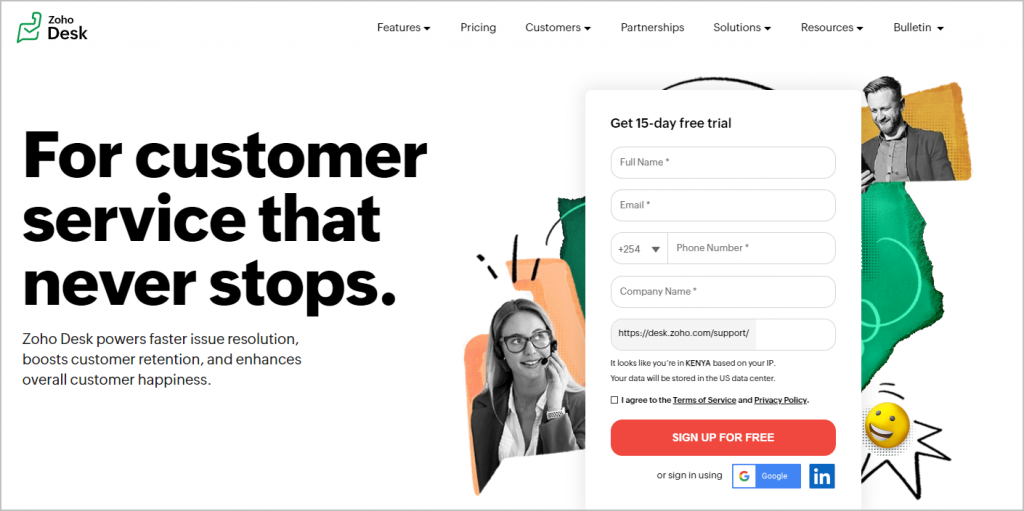
Zoho Desk is a cloud-based good customer service platform that offers ticketing, automation, and multichannel support tools. As part of the Zoho ecosystem, it integrates seamlessly with Zoho CRM, Zoho Analytics, and other Zoho apps, making it ideal for businesses already using Zoho products.
Features:
- Multi-Channel Ticketing: Manage emails, calls, live chats, and social media interactions from a centralized platform.
- Context-Aware Support: Access complete customer history, previous tickets, CRM data, and interaction context in one view.
- Automation and Workflows: Automate ticket assignment, responses, escalations, and SLA notifications for efficiency.
- Self-Service Portal: Build branded help centers, knowledge bases, and community forums for customer self-help.
- Zoho Ecosystem Integration: Connect seamlessly with Zoho CRM, Books, Analytics, Projects, and 40+ Zoho apps.
- Affordable Pricing: Cost-effective plans with transparent pricing suitable for small to mid-sized businesses.
Limitations:
- Ecosystem Lock-In: Works best for teams already using Zoho products; limited value for non-Zoho users.
- Limited Advanced Features: May lack depth and sophistication compared to enterprise-grade platforms like Zendesk or Salesforce.
Best For:
- Zoho Users: Businesses already invested in the Zoho ecosystem seeking integrated support solutions.
- SMBs: Small to mid-sized companies seeking affordable, easy-to-deploy ticketing solutions with growth potential.
- Teams Needing CRM Integration: Organizations wanting tight alignment between support and sales operations.
10. Konverso.ai
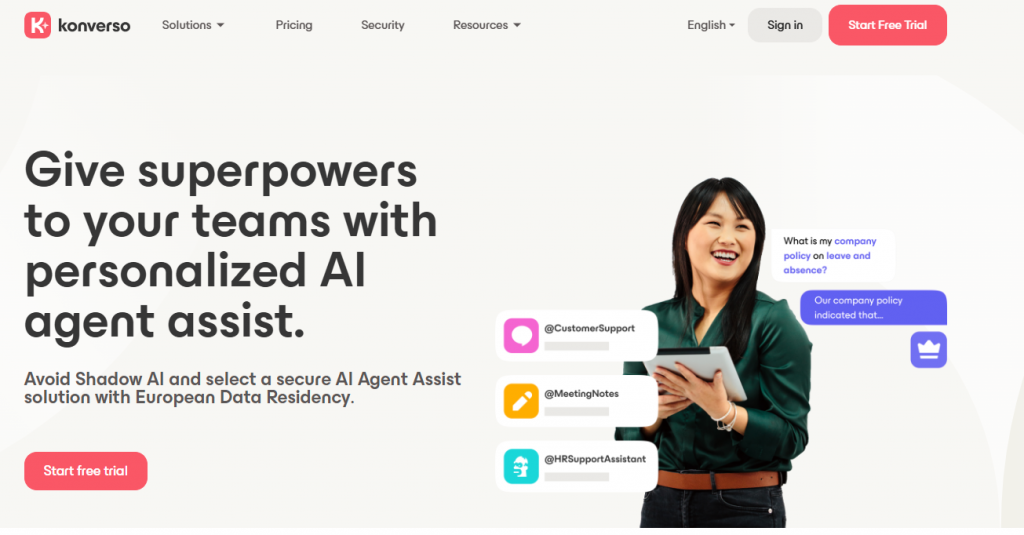
Konverso.ai is an AI-powered IT service management (ITSM) platform that automates IT support, incident management, and employee service requests. It connects with ServiceNow, Jira Service Management, and other ITSM tools to provide intelligent virtual agents for internal IT operations.
Features:
- ITSM Automation: Handle password resets, software requests, ticket creation, and service requests automatically via AI.
- ServiceNow Integration: Native connection with ServiceNow for seamless ITSM workflows, incident management, and approvals.
- Multi-Language Support: Assist global IT teams and employees in their preferred languages across all regions.
- Incident Management: Automatically categorize, prioritize, route, and escalate IT incidents based on urgency and context.
- Knowledge Base Integration: Pull answers from internal documentation, wikis, Confluence, and IT knowledge repositories.
- Analytics and Reporting: Track automation rates, ticket deflection, resolution times, and employee satisfaction scores.
Limitations:
- IT-Specific Use Case: Designed primarily for IT service management and helpdesk operations, not general customer support.
- Enterprise Focus: Pricing structure and features target mid-market to enterprise organizations with IT departments.
Best For:
- IT Service Desks: Teams managing internal IT support, helpdesk operations, and employee service requests at scale.
- ServiceNow Users: Organizations leveraging ServiceNow for ITSM workflows seeking AI-powered automation.
- Large Enterprises: Companies with high volumes of IT service requests, incidents, and complex approval workflows.
How to Choose the Right Maven AGI Alternative for Your Business
Selecting the right platform requires understanding your team’s capabilities, business objectives, and growth trajectory. The best solution helps you automate faster, communicate better, and scale without technical friction.
1. Match the Platform with Your Team’s Skills
Before comparing features, assess your team’s technical strengths. If your team is non-technical, choose a platform that allows easy visual building without writing code. YourGPT AI is ideal because it combines no-code simplicity for quick setup with advanced visual design for building complex automation when needed. For technical teams managing internal IT workflows, tools like Konverso.ai or ServiceNow integrations provide deeper control.
2. Define Your Use Case Clearly
Each business has different automation goals. For customer support and lead generation, YourGPT AI, Intercom, and Ada work effectively. For ecommerce-specific support, Gorgias is purpose-built for Shopify stores. For employee experience and internal automation, Leena.ai fits best. Identify whether your main objective is support automation, conversational sales, internal IT support, or process optimization, then choose a platform that aligns directly with it.
3. Look for Ready Integrations
Smooth integration with your existing tools is essential. Check for compatibility with CRMs, helpdesks, ecommerce platforms, and communication channels such as WhatsApp, Facebook Messenger, and Slack. YourGPT AI, Yellow.ai, and Zendesk stand out for their wide integration range and quick setup across multiple systems. If you’re in the Zoho ecosystem, Zoho Desk provides native connectivity.
4. Choose Transparent and Predictable Pricing
Prefer platforms that offer clear pricing instead of variable charges per interaction or hidden scaling costs. Predictable, tiered plans make budgeting easier and prevent cost escalation as usage increases. Always review the total cost of ownership including setup, training, and ongoing maintenance. Gorgias and Zoho Desk offer transparent entry-level pricing, while enterprise platforms like Yellow.ai and Ada typically require custom quotes.
5. Prioritize Features that Matter Most
Look for core capabilities such as a no-code builder, live chat with human handoff, analytics, and multi-channel support. Advanced automation should work immediately without requiring deep technical knowledge. YourGPT AI combines simplicity with power, making it suitable for both business and technical teams. For ecommerce, prioritize order management and revenue tracking (Gorgias). For IT, prioritize ITSM integration and incident management (Konverso.ai).
6. Look for Long-Term Value
Cheaper tools often limit scalability or demand more manual setup. The best approach is to evaluate how much time, efficiency, and customer value a platform delivers over its lifetime. Choose a solution that reduces technical complexity, supports growth, and delivers measurable returns over time. Consider vendor stability, update frequency, and community support when making your decision.
FAQ
Which Maven AGI alternatives are easiest for non-technical users? ▼
YourGPT AI, Gorgias, and Zoho Desk work well for teams without coding skills. Each offers drag-and-drop builders, templates, and guided workflows, so you can create and launch chatbots without relying on developers.
Why is YourGPT AI a better Maven AGI alternative in 2026? ▼
YourGPT AI helps teams launch AI automation faster. It combines a no-code builder, real-time learning, and built-in support for WhatsApp, Slack, Instagram, and websites. It removes the setup hurdles that slow down Maven AGI users and focuses on clear, measurable results.
Which option works best for ecommerce stores? ▼
Gorgias is built for ecommerce and connects directly with Shopify, Magento, and BigCommerce. It handles order updates, customer messages, and revenue tracking. If you want more flexible automation for sales and marketing, YourGPT AI can handle that too.
Can I use these platforms for internal employee support? ▼
Yes. YourGPT AI, Leena.ai, and Konverso.ai can handle internal support tasks like HR questions, IT requests, or onboarding. You can train a chatbot to answer policy questions, process leave requests, or direct employees to the right team.
Which alternatives offer strong AI without a complex setup? ▼
YourGPT AI, Ada, and Yellow.ai come with built-in AI understanding. They manage multi-turn conversations, remember context, and complete workflow actions. You don’t need machine-learning knowledge or technical setup.
Do these platforms connect with CRMs and helpdesks? ▼
Yes. YourGPT AI, Ada, and Yellow.ai integrate with Salesforce, HubSpot, Zendesk, and Freshdesk. Zoho Desk connects across the entire Zoho suite, making it a good choice for businesses already using Zoho tools.
How long does it take to deploy a chatbot with YourGPT AI? ▼
Most teams launch their chatbot within hours. The visual builder, prebuilt workflows, and ready integrations cut out the long setup time that other tools require.
Are these platforms good for large enterprises? ▼
Yes. YourGPT AI, Yellow.ai, and Ada all support enterprise use. They follow SOC 2 and GDPR standards, manage high chat volumes, and keep data secure while running complex workflows across multiple teams.
Which platform fits best for Shopify users? ▼
Gorgias is ideal if you want to manage orders and messages directly in your helpdesk. If you also want to automate product suggestions, upsells, or marketing chats, YourGPT AI can work alongside it.
How do I choose the right Maven AGI alternative for my team? ▼
Think about what matters most to your team: If you want no-code speed, choose YourGPT AI. If you run Shopify support, go for Gorgias. If you need HR or IT automation, try Leena.ai or Konverso.ai. For enterprise chat and voice AI, consider Yellow.ai. The right pick depends on your goals and how your team works.
Conclusion
Choosing the right Maven AGI alternative means finding a platform your team can use without constant technical support. Maven AGI works for enterprise automation, but most teams need faster setup, clearer pricing, and less complexity.
YourGPT AI solves these problems. You build AI agents using your business documents, FAQs, and website content through a simple visual interface. Deploy across WhatsApp, Slack, Instagram, Messenger, websites, and voice from one place. No coding required.
The platform connects directly to your CRM, helpdesk, and communication tools. You launch in hours, not weeks. Pricing stays predictable as you grow. Both technical and non-technical team members build and modify workflows without bottlenecks.
Teams using YourGPT AI see faster response times, systematic lead qualification, and automated routine tasks. Support costs drop while customer satisfaction rises. Your team focuses on conversations that need human judgment instead of repetitive questions.
If you want AI that delivers results without technical overhead, YourGPT AI gives you the tools to start quickly and scale confidently.
Top Maven AGI Alternatives Worth Considering in 2026
Compare leading platforms that offer powerful AI automation, strong integrations, and reliable performance for teams planning their next upgrade.
Independent analysis • Updated for 2026 • Built for real business decisions
Leave a Reply