Forethought is an AI-powered support automation platform designed to build intelligent agents for ticket deflection and intent-based workflows, primarily targeting mid-market and enterprise support teams managing high volumes of tickets.
This blog reviews ten Forethought options in 2026 that offer clearer pricing, faster deployment, and better customization. The selection ranges fromno-code builders for small businesses to enterprise-grade platforms and social media solutions. Each platform helps businesses create, manage, and scale AI-driven support with greater efficiency and transparency.
Why Businesses Are Exploring Forethought Alternative?
Businesses are exploring alternatives to Forethought primarily due to several practical challenges that impact budgeting, implementation, and flexibility.
Forethought is an AI-powered support automation platform aimed at mid-market and enterprise teams with high ticket volumes. However, user feedback reveals common pain points driving the search for other solutions:
1. Opaque Pricing
Forethought does not publish standard pricing, requiring multiple sales calls to get a quote. Costs vary widely with usage, making predictable budgeting difficult for many teams.
2. High Data Requirements
Users often need to provide 20,000 or more historical tickets for training, which is unfeasible for startups or small teams looking to implement AI support quickly
3. Lengthy, Technical Setup
Deployment typically takes 6–8 weeks, involving ongoing data cleanup and intent maintenance. This demands dedicated technical resources, which many teams lack.
4. Rigid Workflow Constraints
Customizing workflows to specific business needs often requires add-ons or professional services, limiting agility and control over customer journeys.
5. Cost Escalation Risks
Additional AI features, extra communication channels, and advanced workflow modules can significantly increase total costs beyond initial estimates, complicating expense management as ticket volume grows.
For organizations facing these issues, alternative platforms provide clearer pricing, faster implementation, and more flexible automation capabilities without sacrificing AI sophistication.
These platforms make AI support easier to access, scale, and budget helping businesses avoid the complexities associated with Forethought’s model.
10 Best Forethought Alternatives in 2026: Complete Comparison
Forethought has high starting costs, unclear pricing, and automation that is hard to adjust. These issues can get in the way as support teams grow. We reviewed ten better alternatives for customer support in 2026 so you can choose the one that works best for your team.
1. YourGPT
YourGPT is an AI-first platform for building and deploying AI agents without coding. It helps businesses manage customer support, sales, and operations from a single workspace that connects effortlessly with websites, WhatsApp, Slack, Messenger, Instagram, LINE, email, and voice channels.
Key Features
- No-Code Builder : Create intelligent chatbots from documents, FAQs, website links, or custom workflows. The visual builder works for both technical and non-technical teams. For advanced use cases, the AI Studio offers deeper flow logic and API-based actions.
- Custom Knowledge Bases : Train agents on your own content so they answer with accurate, context-aware responses that match your brand’s tone and policies.
- AI Copilot Builder: Enables agents to reason, plan, and perform multi-step tasks autonoumously on backend and frontend based on conversations.
- Multiple input understanding (multi-modal): Customers can describe their problem using text, voice, or images, giving them more freedom and clarity.
- Omnichannel Deployment : Deploy once and connect across WhatsApp, Messenger, Instagram, LINE, Slack, Telegram, and websites ensuring a unified experience everywhere.
- Voice Agents : Add AI-powered phone and voice support that understands natural speech and responds instantly.
- Lead Generation Tools : Capture and qualify leads using forms, workflows, and routing all automated through the agent.
- AI Helpdesk Integration : Provide AI self-service for common questions with instant handoff to live agents when needed, keeping full conversation context.
- Human Handoff : Switch conversations to support agents with complete history and metadata intact.
- Analytics Dashboard : Monitor resolution rates, CSAT, AI performance, usage trends, and ROI.
- Self-Learning System : Agents improve continuously from interaction data without manual retraining.
Pricing
Unlike Forethought’s hidden pricing, YourGPT publishes its plans:
- Essential Plan: $39 per month
- Professional Plan: $79 per month
- Advanced Plan: $349 per month
- Enterprise Plan: Custom pricing based on requirements
All plans include a free trial, and pricing scales predictably with usage. No surprise fees or hidden costs.
Limitations
- Trial Limitations: The free version includes essential features, while advanced automation tools are part of paid plans.
- Quick Product Iteration: YourGPT is developed by a fast moving team that releases updates frequently. Some new features may evolve quickly or change based on user feedback.
Best For
- Support Teams: Scaling customer support without increasing headcount.
- Sales Teams: Automating lead qualification and follow-up processes.
- Operations & IT: Managing internal workflows and task automation.
- Agencies: Running multiple client chatbots with flexible control.
2. Zendesk Support Suite
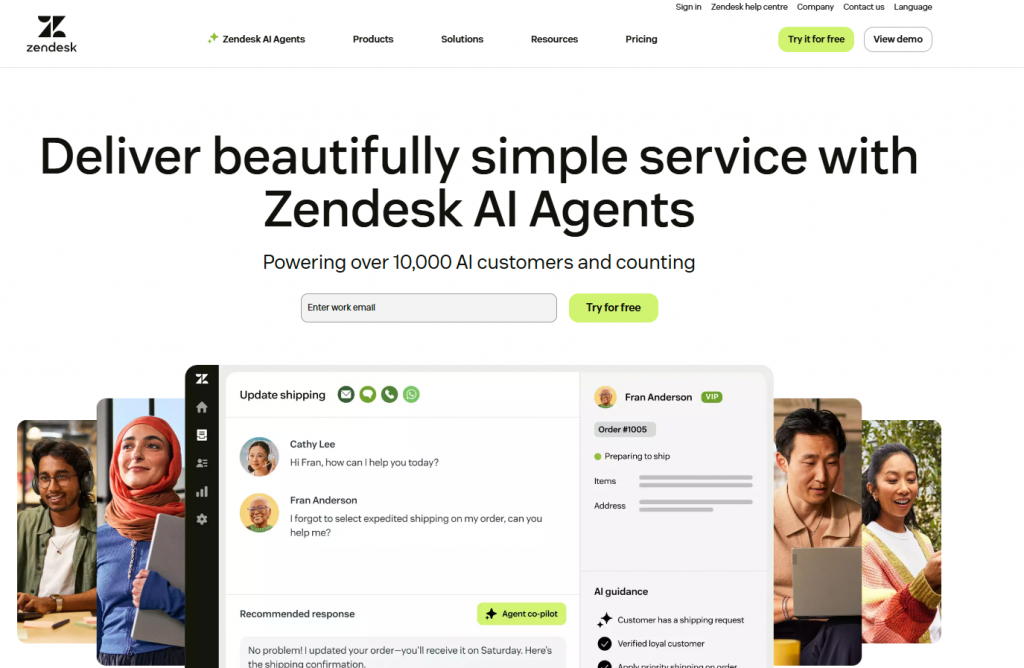
Zendesk is one of the most established platforms for customer support, offering ticketing, live chat, voice, a knowledge base, and workflow automation in one system. It is widely used by larger organisations that need a mature, scalable solution with extensive integration support.
Key Features
- Omnichannel Workspace : Manage email, chat, social messaging, and voice in a unified dashboard with complete customer profiles.
- Zendesk AI Agents: AI-powered suggestions, automated responses, and routing to speed up support operations.
- 1,800+ Integrations : A large marketplace of apps covering CRMs, analytics tools, marketing systems, and communication channels.
- Reporting & Analytics : Comprehensive dashboards tracking SLAs, agent activity, backlog trends, CSAT, and ticket performance.
- Voice Support : Includes call centre capabilities through Zendesk Talk.
- Self-Service Tools : Create help centres, knowledge bases, and community spaces for customer self-service.
- Workflow Automation : Use macros, triggers, and custom routing rules to automate repetitive processes.
- Mobile Apps : iOS and Android apps for managing support on the go.
Pricing
Support Team: $19/agent/month
Suite Team: $55/agent/month
Suite Professional: $115/agent/month
Suite Enterprise: $169/agent/month
AI capabilities often require add-on purchases, increasing the total cost.
Limitations
- Pricing rises quickly when AI and automation add-ons are included
- Steeper learning curve for new teams
- AI functionality is less advanced compared to newer AI-native platforms
- Per-agent pricing becomes costly as support teams scale
Best For
- Established businesses with larger support teams
- Organisations that rely on structured, multi-step workflows
- Companies that require deep customization across tools and processes
- Teams needing integrations across multiple channels and systems
3. Intercom
Intercom is a conversational platform centred around real-time messaging and in-app engagement. It is built for product-led SaaS companies that want to communicate directly inside their product while automating parts of the support workflow. Intercom combines live chat, behavioural targeting, and product tours in one system, with Fin AI powering automated responses.
Key Features
- Fin AI Agent : AI-powered automated responses that handle common queries inside chat.
- In-App Messaging & Live Chat : Real-time conversations directly within your website or product.
- Customer Journey Tracking : Segmentation, behavioural insights, and lifecycle tracking to personalise engagement.
- Product Tours & Onboarding: Tools to guide new users, launch tutorials, and run interactive walkthroughs.
- Shared Team Inbox: Centralised workspace for assigning, replying, and collaborating on customer conversations.
- CRM Integrations : Connects with major CRMs to sync user data and events.
- Mobile SDK : Enables in-app support and messaging inside iOS and Android apps.
Pricing
- Essential Plan: $29/seat/month
- Advanced Plan : $85/seat/month
- Expert Plan : $132/seat/month
Limitations
- Becomes expensive as teams grow
- AI and automation require higher-tier plans
- Locked into the Intercom ecosystem with fewer external options
- More complex than required if the focus is only on support, not full lifecycle messaging
Best For
- SaaS companies prioritising in-app messaging
- Teams focused on proactive engagement and lifecycle communication
- Businesses that need onboarding flows, product tours, and behaviour-based messaging
4. Freshdesk
Freshdesk is an affordable customer support platform designed for teams that want a straightforward, easy-to-use system. It offers quick setup, simple ticket management, and useful automation. With Freddy AI, it helps small and mid-sized teams handle customer questions across multiple channels.
Key Features
- Freddy AI Automation : Automates replies, ticket categorisation, and routing.
- Multi-Channel Ticketing : Handles support across email, chat, phone, social media, and web portals.
- Team Collaboration Tools : Includes a shared inbox, assignments, collision detection, and internal notes.
- Knowledge Base & Self-Service : Create FAQs, help articles, and customer-facing support portals.
- Custom Workflows & SLAs : Automate repetitive actions and enforce SLA rules for timely responses.
- 1000+ Integrations : Large marketplace with CRM, analytics, telephony, e-commerce, and productivity apps.
Pricing
- Growth: $18/agent/month
- Pro: $59/agent/month
- Enterprise: $95/agent/month
Limitations
- AI capabilities are more basic compared to AI-native platforms
- Many advanced features are available only on higher-tier plans
- Less flexible for complex, enterprise-level workflow customization
Best For
- Small to medium businesses
- Teams needing an affordable support solution
- Companies looking for essential ticketing, basic automation, and quick setup
5. Salesforce Service Cloud
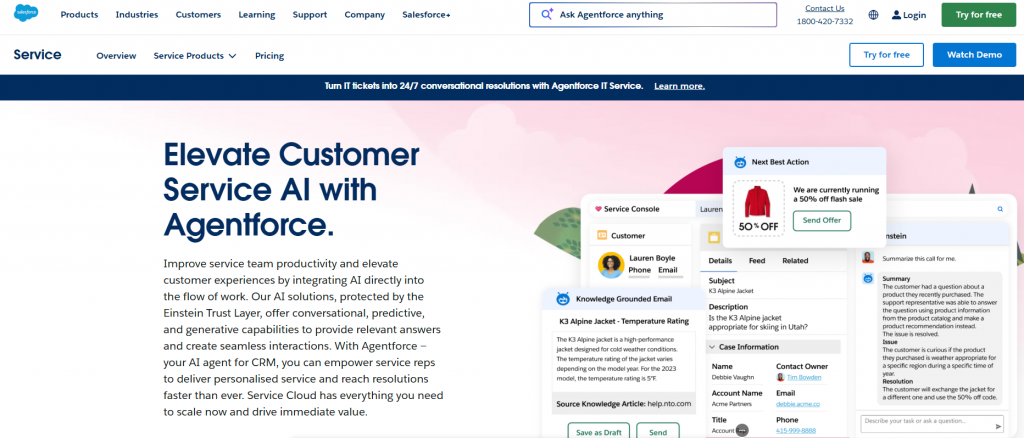
Salesforce Service Cloud is an enterprise-grade customer support platform designed for organisations that need advanced automation, deep CRM connectivity, and a unified view of every customer interaction. It offers powerful workflow customisation, extensive analytics, and tight integration across the Salesforce ecosystem. With Agentforce and Einstein AI, large teams can automate case management, improve routing accuracy, and make data-driven support decisions at scale.
Key Features
- Agentforce AI for Automation : Automates case handling, responses, and workflow execution.
- Einstein AI Insights : Provides predictions, recommendations, and next-best actions.
- 360-Degree Customer View : Centralised profiles combining CRM data, interactions, and history.
- Omnichannel Routing : Routes cases across chat, voice, email, SMS, and social channels.
- Advanced Analytics & Reporting : Offers detailed dashboards for performance, forecasting, and service metrics.
- Native Salesforce Integration : Connects seamlessly with Sales Cloud, Marketing Cloud, Commerce Cloud, and custom Salesforce apps.
Pricing
- Starter: $25/user/month
- Professional: $100/user/month
- Enterprise: $165/user/month
- Unlimited: $330/user/month
Limitations
- Complex setup and configuration
- Higher cost makes it difficult for SMBs
- Requires Salesforce admin expertise
- Longer implementation and onboarding timelines
Best For
- Organisations that need advanced automation and fully connected workflows
- Large enterprises
- Companies using Salesforce CRM across departments
6. Kayako

Kayako is designed for teams that want a balance between AI-driven efficiency and human support. Its focus is on smooth transitions, intelligent routing, and preserving full conversation context when escalating from AI to a human agent. This makes Kayako a good fit for companies that value personalised support while still adopting AI automation.
Key Features
- AI-Based Routing & Automation : Routes conversations intelligently and automates basic tasks.
- Smooth AI-to-Human Handoff : Transfers cases to human agents with full context and conversation history.
- Multi-Channel Support : Handles email, chat, social, and messaging channels in one workspace.
- Live Chat & Messaging : Real-time support for website and in-app users.
- Customer Journey Tracking : Shows complete interaction history for better agent understanding.
- Team Collaboration Tools : Shared views, internal notes, and collaborative workflow features.
Pricing
- Custom pricing — contact sales
Pricing is not publicly listed and depends on team size and required features.
Limitations
- No public pricing available
- Advanced features are tied to higher-tier plans
- AI capabilities are more limited compared to AI-first platforms
Best For
- Companies wanting a hybrid model of AI + human support
- Teams prioritising smooth escalation and contextual conversations
- Businesses focusing on personalised customer experiences
7. Kore.ai
Kore.ai is built for large enterprises that need conversational AI, strong NLP capabilities, and strict security controls. It supports both voice and chat automation, making it suitable for industries that require high accuracy, compliance, and large-scale deployments. With custom workflow building and deep integration options, Kore.ai is designed for highly technical teams managing complex automation projects.
Key Features
- Advanced Natural Language Processing : Industry-grade NLP for understanding intent, context, and complex queries.
- Multi-Channel Bot Deployment : Deploy AI agents across web, mobile, voice, messaging apps, and enterprise systems.
- Enterprise-Grade Security & Compliance : Meets requirements for regulated industries including finance, healthcare, and government.
- Custom AI Workflow Builder : Build sophisticated automation, logic, and task flows.
- Integration APIs : Connect with internal systems, CRMs, ERPs, and data sources.
- Voice & Chat Capabilities : Supports contact center automation, voice IVR, and conversational chatbots.
Pricing
- Essential: $50/month
- Advanced: $150/month
- Enterprise: Custom pricing (often starting around $300K/year)
Limitations
- High cost for enterprise plans
- Complex setup requiring experienced technical teams
- No public enterprise pricing
- Not suitable for SMBs or early-stage startups
Best For
- Large enterprises in regulated industries
- Organisations requiring strict compliance and advanced NLP
- Companies needing scalable, multi-channel conversational AI deployments
8. ServiceNow
ServiceNow Customer Service Management (CSM) extends the company’s ITSM foundation into customer service, offering powerful workflow automation and deep operational visibility. It is designed for large enterprises that need complex case management, cross-departmental workflows, and strong integration with internal systems. With AI insights and self-service capabilities, ServiceNow CSM helps organisations streamline high-volume, process-driven support operations.
Key Features
- End-to-End Workflow Automation : Automates complex processes across teams, departments, and systems.
- Advanced Case Management : Handles multi-step cases with detailed tracking, routing, and escalation.
- Multi-Channel Support : Covers email, chat, phone, portals, and external integrations.
- Extensive Integrations : Connects deeply with ITSM, third-party tools, CRMs, ERPs, and enterprise systems.
- AI-Powered Insights : Provides recommendations, anomaly detection, and service intelligence.
- Self-Service Portals : Customisable portals for customers to find answers, track cases, and submit requests.
Pricing
- Enterprise-focused with custom pricing
Pricing is not publicly listed and varies by implementation size and required modules.
Limitations
- Too heavy and complex for SMBs
- Long and complex implementation cycles
- High total cost of ownership
- Requires dedicated internal teams to manage and maintain
Best For
- Large enterprises
- Organisations already using ServiceNow for ITSM
- Companies needing highly automated, cross-departmental workflows
9. Helpshift
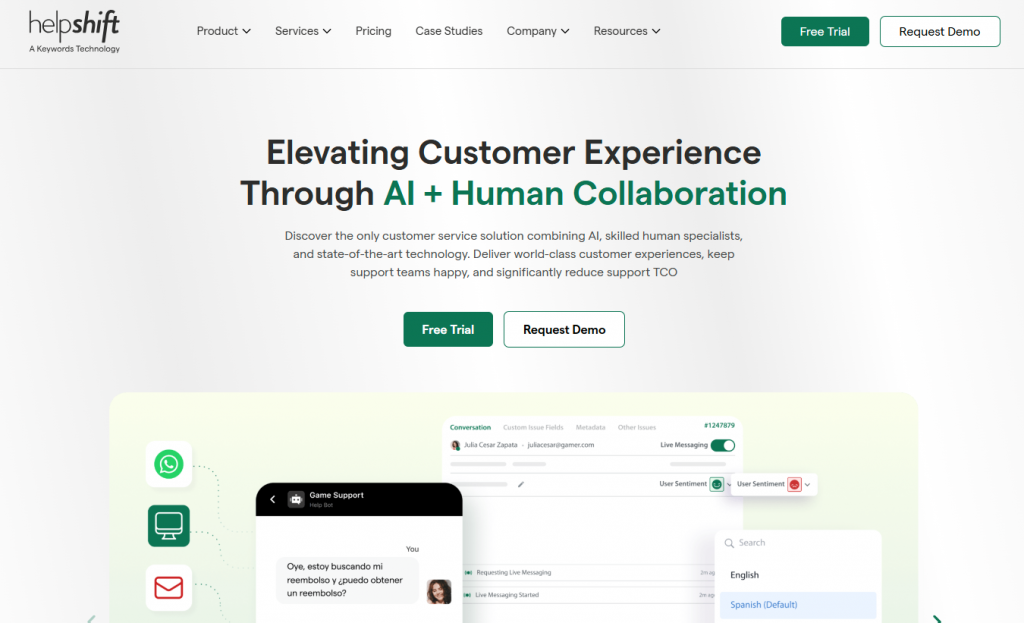
Helpshift is designed specifically for mobile apps and gaming companies that need fast, in-app customer support. Its mobile SDK allows teams to deliver embedded chat experiences directly inside their apps, while AI agents and automated workflows help reduce manual workload. With real-time analytics and an issue-based pricing model, Helpshift offers a flexible approach for teams managing high mobile traffic.
Key Features
- In-App Messaging & Support : Native chat experience embedded directly inside mobile apps.
- AI Agent & Copilot : Automates replies, triage, and routine support workflows.
- Issue-Based Pricing Model : Pay based on the number of issues instead of agents.
- Mobile SDK Integration : Easy integration with iOS, Android, and gaming platforms.
- Automated Workflows : Handles routing, triggers, and common support actions.
- Real-Time Analytics : Tracks issue trends, response times, and in-app user behaviour.
Pricing
- Feedback+ Plan: Free (limited)
- Starter: $150/month (includes 250 issues; $0.45 per additional issue)
- Growth & Enterprise: Custom pricing
Limitations
- Less suitable for web-first or desktop-first companies
- Costs can rise quickly with high issue volume
- Lower plans include fewer AI and bot features
Best For
- Mobile app developers
- Gaming companies
- Teams needing fast, embedded in-app support with automation
10. Gladly
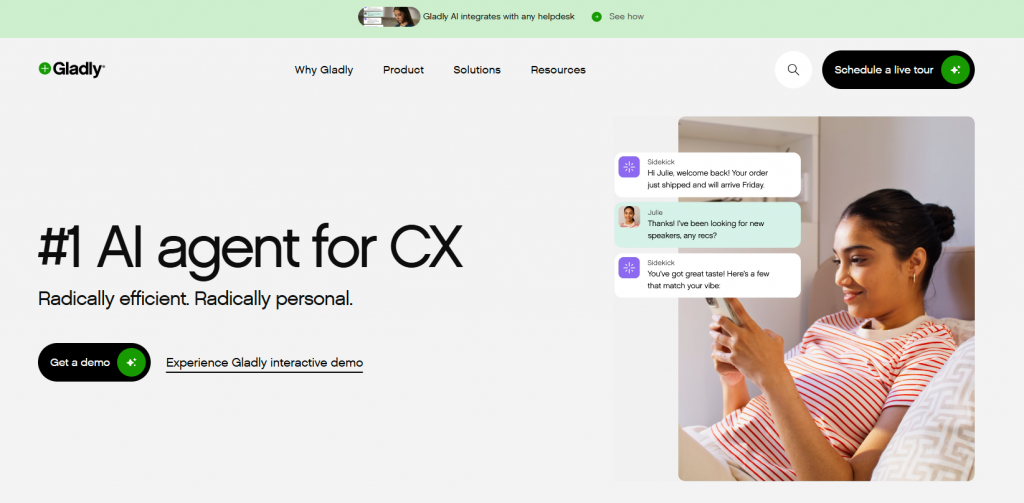
Gladly is designed to replace traditional ticket-based systems with a people-centered support model. Instead of breaking conversations into ticket numbers, Gladly keeps every interaction across all channels organized under a single, lifelong customer conversation. With native voice, messaging, and automation, Gladly helps teams deliver personalised service at scale, especially for retail and consumer brands.
Key Features
- People-Centered Conversation Model : Organises interactions by customer, not by tickets.
- Unified Omnichannel Inbox : Manage voice, SMS, email, chat, and social messages from one timeline.
- Gladly Sidekick (AI Assistant) : Automates responses, FAQs, and self-service flows.
- Built-In Voice Support : Native call routing, IVR, and voice experience directly inside the platform.
- Customer History & Profiles : Rich profiles with past conversations, purchases, preferences, and loyalty data.
- Workflow & Routing Tools : Skills-based routing, assignments, and team collaboration features.
Pricing
- Hero Plan: $150/agent/month
- Superhero Plan: $180/agent/month
- Enterprise: Custom pricing
Limitations
- More expensive than traditional ticketing platforms
- Not ideal for SMBs with simple support needs
- People-centered model requires process changes for some teams
Best For
- Retail and eCommerce brands
- Companies prioritising personalised, relationship-based customer service
- Teams wanting a unified omnichannel timeline with AI + human support
Forethought vs Alternatives: Quick Comparison Table
Here’s a quick comparison of all 10 Forethought alternatives:
Intercom, Zendesk, Freshdesk, and Gladly focus more on traditional support and messaging. Salesforce Service Cloud, Kore.ai, and ServiceNow CSM target complex enterprise workflows. Helpshift and Kayako specialise in mobile and hybrid AI + human support models.
| Feature | YourGPT | Intercom | Zendesk | Freshdesk | Service Cloud | Kayako | Kore.ai | ServiceNow CSM | Helpshift | Gladly |
|---|---|---|---|---|---|---|---|---|---|---|
| Easy setup | Yes no-code quick start | Moderate SaaS-focused setup | Moderate needs configuration | Yes simple for SMB teams | No enterprise implementation | Moderate for support teams | No needs technical team | No long rollout cycles | Moderate mobile SDK work | Moderate but opinionated |
| Training and data | Multi-source RAG on your data | Uses workspace + product data | KB + tickets + apps | KB + emails + tickets | Full CRM + service data | Help center + history | Intent/entity based training | Service + IT + asset data | In-app and game events | Customer history + orders |
| Self-learning AI | Yes feedback-driven improvement | Partial via Fin tuning | Limited assistive AI | Basic suggestions only | Yes via Einstein models | Limited learning signals | Yes model refining possible | Yes tied to service data | Limited pattern learning | Limited AI adaptation |
| Persistent memory | Yes per user and account | Mostly session + profile data | Ticket-level not true memory | Ticket + contact records only | Full CRM history per contact | Conversation history focused | Configurable memory structures | Service records as memory | Per-device and user history | Customer lifetime timeline |
| Advanced automation | Yes deep workflows and actions | Strong but product-led focus | Macros + flows + triggers | Rules + SLAs + scenarios | Enterprise-grade automation | Good routing and escalation | Very advanced bot workflows | End-to-end workflow engine | In-app flows and triggers | Routing + sidekick automation |
| Multi-step workflows | Yes visual flow builder | Yes journeys and series | Yes with workflow builder | Yes scenarios and automations | Yes process builder / flows | Basic multi-step paths | Yes complex dialog flows | Yes cross-department flows | Yes issue-based chains | Yes for service scenarios |
| API and backend actions | Yes custom API + tools | Yes via apps and webhooks | Yes rich app marketplace | Yes apps + webhooks | Yes native and custom APIs | Limited compared to others | Yes deep enterprise APIs | Yes across IT and service | SDK + integrations | Yes commerce + CX systems |
| Omni-channel (web, mobile, voice, social) | Yes web, chat, WhatsApp, voice | Yes in-app, email, chat, social | Yes email, chat, voice, social | Yes multi-channel ticketing | Yes full contact center suite | Yes main digital channels | Yes web, voice, messaging | Yes portals, chat, phone, more | Strong in-app + messaging | Yes voice, SMS, email, social |
| Unified inbox | Yes across all channels | Yes shared inbox | Yes agent workspace | Yes team inbox | Yes console view | Yes conversation view | Agent consoles per channel | Service console workspace | In-app centric inbox | Yes people-based timeline inbox |
| Mobile app | Yes operator mobile support | Yes iOS and Android | Yes agent mobile apps | Yes mobile apps | Yes Salesforce mobile | Browser-first limited mobile | Yes admin/agent tools | Yes ServiceNow mobile | SDK inside mobile apps | Yes for agents |
| Web / browser extension | Yes browser extension for support | No dedicated extension | No dedicated extension | No dedicated extension | No dedicated extension | No | No | No | No | No |
| Integrations | Shopify CRMs APIs webhooks | Product + CRM + data tools | Large marketplace ecosystem | Marketplace + telephony + CRMs | Full Salesforce stack + partners | Core support tools | Enterprise apps and systems | ITSM + ERP + custom systems | Mobile backends + CRMs | Commerce, CX and loyalty tools |
| Brand and workflow control | High tone + flows + logic | Strong control in product journeys | Flexible but ticket-centric | Good for simple workflows | Very high but complex | Moderate hybrid focus | High developer-driven control | Very high enterprise control | Good for in-app flows | Strong people-first experience |
| Analytics and reports | Yes AI + support analytics | Strong engagement analytics | Mature reporting and SLAs | Good out-of-box dashboards | Advanced enterprise analytics | Standard support insights | Advanced conversation analytics | Service intelligence and trends | In-app issue analytics | Customer lifetime insights |
| AI features and models | GPT-4/Claude + RAG + agents | Fin AI for support | Zendesk AI assistants | Freddy AI suggestions | Einstein + Agentforce | AI routing and handoff | Enterprise NLP engine | Now Intelligence AI | AI agent and copilot | Gladly Sidekick AI |
| Security and compliance | SOC2, GDPR friendly | Strong SaaS security | Enterprise-grade standards | Good for SMB to mid-market | Enterprise and regulated-ready | Solid but narrower scope | Strong for regulated sectors | Enterprise and public sector | Good app security | Enterprise retail standards |
| Best fit | SMBs, mid-market, enterprises needing AI agents, automation, and omni-channel | Product-led SaaS with strong in-app engagement | Established support teams with high ticket volume | Small to medium teams wanting affordable support | Large enterprises already on Salesforce | Teams wanting hybrid AI + human escalation | Enterprises needing advanced NLP and voice | Enterprises with ITSM and complex workflows | Mobile app and gaming companies | Retail and D2C brands focusing on relationships |
How to Choose the Right Forethought Alternative
Selecting the right support automation platform starts with understanding how well it matches your team’s skills, business goals, and long-term plans. The ideal Forethought alternative should help you automate faster, improve resolution times, and scale support without adding operational friction.
1. Match the Platform with Your Team’s Skills
Before comparing features, assess how technical your team is. If your team is non-technical, choose a platform that offers quick setup and visual automation without writing code. YourGPT fits well here because it supports simple no-code building and also provides deeper workflow options when needed. If your team includes engineers or IT specialists, tools like Salesforce Service Cloud, ServiceNow CSM, or Kore.ai give you more control and advanced customisation.
2. Define Your Use Case Clearly
Different teams adopt AI support tools for different outcomes. If your goal is reducing ticket load and improving first response times, YourGPT, Intercom, and Zendesk are effective options. If you need structured case management or complex workflow automation, Salesforce Service Cloud or ServiceNow CSM may fit better. For mobile-focused products, Helpshift delivers strong in-app experiences. Knowing your goals helps you select the platform that aligns directly with your support priorities.
3. Look for Ready Integrations
Smooth integration with your existing systems is essential. Check whether the platform connects easily with your CRM, helpdesk, e-commerce platform, and communication channels such as WhatsApp, email, Instagram, or voice. YourGPT, Intercom, Zendesk, and Salesforce offer broad integration support. Enterprise ecosystems are better supported by Kore.ai and ServiceNow, while Helpshift specialises in mobile integrations.
4. Choose Transparent and Predictable Pricing
Clear pricing is important when planning long-term support budgets. Select platforms that offer straightforward plans instead of unpredictable usage-based charges. Predictable pricing helps you manage costs as your customer volume grows. Always consider the total cost, including onboarding, setup, and potential add-ons.
5. Prioritise Features that Matter Most
Focus on features that directly improve your support workflow. Look for a no-code builder, human handoff, analytics, and multi-channel coverage. Automation should be easy to use without deep technical setup. YourGPT offers both simplicity and advanced automation, making it suitable for a range of teams. Intercom and Zendesk are strong for messaging workflows, while Salesforce Service Cloud and Kore.ai offer extensive enterprise capabilities.
6. Look for Long-Term Value
The right platform should continue delivering value as your business grows. Evaluate how well it reduces manual work, improves customer response times, and simplifies daily operations. Choose a solution that supports your long-term growth, keeps maintenance low, and provides measurable improvements over time.
Conclusion
Finding the right support platform is not just about features. It is about what actually works for your team. Forethought brought AI to customer service early, but many teams today want something faster to set up, easier to understand when it comes to pricing, and flexible enough to fit how they really work.
YourGPT understands this well. You can get it running quickly, customize it without needing a developer, and use it across all the channels your customers prefer, such as WhatsApp, Instagram, email, and voice. The pricing is clear and grows with your business. There are no surprises or long setup times.
Other platforms also have their strengths. Salesforce Service Cloud and Kore.ai are good for large companies that need deep customization. Intercom works well with SaaS products and in-app messaging. Freshdesk is a budget-friendly option with solid features, and Helpshift focuses on mobile app support.
A Better Way to Add AI to Your Support Team
Choose an AI system that is simple to start, easy to maintain, and built to support real support operations. YourGPT gives teams the control they need without long setup or complex steps.
Designed for modern support teams focused on clarity and speed
Leave a Reply