TL;DR: The Core Difference
YourGPT
Built around AI agents that handle conversations, run workflows, and resolve issues on their own across channels. The goal is to reduce incoming support volume by solving problems before they reach a human.
Freshdesk
Built around structured ticketing. It focuses on organizing queues, managing SLAs, and tracking agent performance. Humans remain responsible for resolving issues, with AI limited to assistance.
If your goal is to reduce support volume and automate complex actions, YourGPT fits better. If your goal is organizing and managing human support workflows, Freshdesk remains the traditional option.
For businesses deciding how they want customer support to function in 2026, the choice is no longer just between “chat or email.” The decision is strategic: Do you want to manage tickets efficiently, or do you want to prevent them entirely?
While both platforms serve customer service teams, they are built on fundamentally different assumptions. Freshdesk is a traditional help desk designed to organize queues and workflows for human agents. YourGPT is a complete AI suite that help business build AI agents for customer support, sales and operations.
This guide compares YourGPT and Freshdesk across AI capabilities, integrations, setup, and pricing to help you decide which platform fits your future.
Quick Overview: YourGPT vs Freshdesk
| Feature | YourGPT | Freshdesk |
|---|---|---|
| Core Philosophy | AI resolves issues before tickets exist | Humans resolve issues after tickets are created |
| Primary Outcome | Improved self-service resolution of support requests | Better organization of human support queues |
| AI Role | Agentic AI that performs tasks and completes requests | Assistive AI that helps agents respond faster |
| Problem Handling | Issues are handled directly in conversations | Issues are converted into tickets |
| Action Capability | Can call APIs, update systems, and perform backend tasks | Limited to predefined macros and rules |
| Setup Approach | Learns from connected websites, files, FAQs, and past conversations | Requires manual article creation and rule setup |
| Knowledge Updates | Reflects changes when connected sources are updated | Knowledge must be manually edited and published |
| Context Scope | Retains context across conversations and channels | Context resets when a ticket is closed |
| Human Involvement | Humans step in only when needed | Human involvement is required for every resolution |
| Pricing Structure | Usage-based pricing without per-agent limits | Per-agent pricing that scales with team size |
| Best Fit Teams | Teams aiming to reduce support load at scale | Teams managing high volumes of human-led tickets |
What Is Freshdesk?
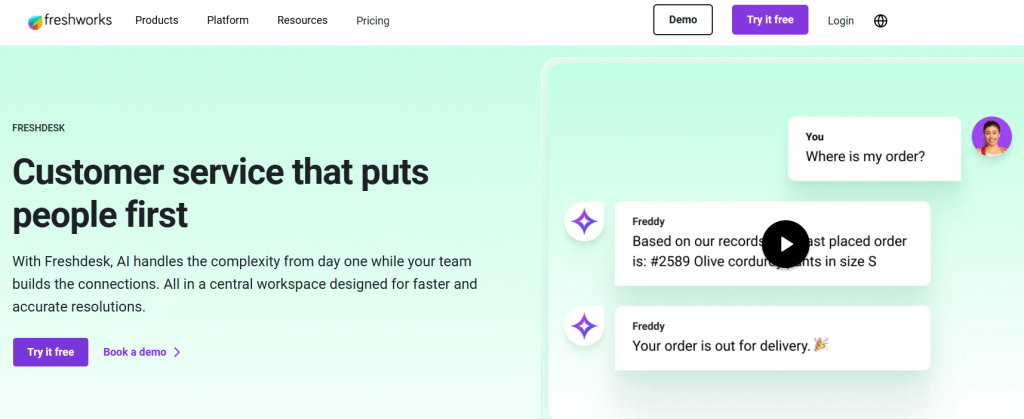
Freshdesk is a customer support platform designed to help teams manage customer queries through a structured, ticket-based system. It focuses on organizing conversations, improving agent productivity, and maintaining service quality across multiple channels such as email, chat, phone, and social media.
Freshdesk combines traditional help desk workflows with AI-assisted features to help agents respond faster and manage higher ticket volumes, while keeping support operations centralized and measurable.
Core Features of Freshdesk:
- Omnichannel Ticketing System : Automatically converts customer queries from email, chat, phone, and social channels into tickets managed from a single dashboard.
- Ticket Automation and SLAs : Use rules, triggers, and SLAs to route tickets, assign priorities, send notifications, and enforce response and resolution timelines.
- Freddy AI for Agent Assistance : Provides AI-powered reply suggestions, ticket categorization, sentiment detection, and basic chatbot capabilities to assist agents during conversations.
- Knowledge Base and Self-Service Portal : Create FAQs, help articles, and customer portals to reduce incoming tickets and support self-service.
- Team Collaboration Tools : Enable internal notes, ticket ownership, collision detection, and agent groups to improve coordination within support teams.
- Reporting and Analytics : Track ticket volume, agent performance, response times, SLA compliance, and customer satisfaction through built-in reports and dashboards.
Freshdesk works best for teams that rely on clear processes, defined support queues, and human-led resolution, with AI acting as a productivity aid rather than a replacement for agents.
Pros of Freshdesk:
- Well-suited for ticket-driven support : Strong structure for managing high volumes of customer requests with clear ownership and tracking.
- Easy to onboard support teams : Familiar help desk interface makes it easy for agents to get started without heavy training.
- Built-in omnichannel support : Email, chat, phone, and social conversations flow into a unified ticket system.
- Solid reporting and SLA management : Helpful for teams that need visibility into performance and compliance metrics.
Cons of Freshdesk
- No SMS or Instagram support out of the box : Many teams need to rely on third-party tools to cover popular messaging channels like SMS and Instagram.
- Automation can feel limited and hard to manage : Rules, triggers, and workflows require careful configuration and can become difficult to maintain as setups grow.
- Basic analytics on lower tiers : Reporting and insights are limited unless teams upgrade to higher plans, which increases overall cost.
- Performance issues during high ticket volume : Some users report slower ticket loading and occasional glitches when support volume spikes.
- Integration limitations : While integrations are available, some lack depth or require additional setup to work reliably.
Pricing
Freshdesk uses a per-agent pricing model with multiple tiers. Pricing and available features depend on the selected plan.
- Growth: $35 per agent/month
- Pro: $83 per agent/month
- Enterprise: $131 per agent/month
This pricing structure works well for stable support teams with predictable headcount, but costs can rise as agent numbers increase.
What Is YourGPT?

YourGPT is an AI agent platform built for businesses that need one system to handle customer support, sales, and operations. YourGPT Powered agents can execute multistep actions calling APIs, updating databases, processing transactions, and completing workflows autonomously. Deploy agents across websites, WhatsApp, Instagram, email, and voice calls, managing all conversations from a unified inbox.
Core Features of YourGPT:
- No-Code AI Agent Builder: An intuitive visual interface that lets support, sales, and marketing teams build and manage AI agents without coding.
- Knowledge Bases: Connect multiple data sources including documents, websites, FAQs, and conversation histories. The AI automatically learns from this information, keeping responses accurate as your content updates. You can add, remove, or modify knowledge sources without retraining from scratch.
- AI Studio for Workflow Automation: Design multi-step workflows visually, connect to your systems through native integrations (Shopify, HubSpot, Salesforce, Zendesk), and trigger actions automatically based on customer interactions.
- Omnichannel Deployment: Deploy across website chat, WhatsApp, Messenger, Telegram, Slack, and voice channels. Manage all conversations from a unified inbox that consolidates interactions across platforms.
- Self-Learning: The AI improves accuracy automatically based on resolved conversations and feedback—no manual retraining required.
YourGPT works for businesses that need AI agents running quickly across multiple channels, with the flexibility to automate workflows and integrate with existing tools. It bridges the gap between simple chatbots and complex custom-built systems.
Pros of YourGPT:
- Complete platform for support, sales, and operations: Handles customer inquiries, lead qualification, appointment scheduling, and transaction completion in one system instead of requiring multiple separate tools.
- Agentic AI capabilities: Agents don’t just respond to questions, they execute actions, update CRMs-databases, and complete tasks across text, voice, and image interactions without human intervention.
- Unified inbox across all channels: Teams manage conversations from website, WhatsApp, Instagram, Telegram, Slack, and phone calls in one dashboard, preventing context loss between platforms.
Cons of YourGPT:
- Fast-moving platform: The team iterates and ships new features frequently, which means the interface and capabilities evolve quickly. Users who prefer stable, unchanging systems may need to adapt regularly.
- Requires basic prompt engineering Knowledge: Getting the best results from AI agents benefits from understanding how to structure instructions effectively. Users without curiosity to learn prompt optimization may need initial guidance.
- Free trial features: The trial version provides access to essential functionality but limits advanced features like API access and workflow automation, requiring upgrade to evaluate full capabilities.
Pricing
YourGPT offers transparent, usage-based pricing with no per-seat costs, making it easier for teams to predict expenses and scale as they grow:
- Essential Plan: $59 per month
- Professional Plan: $129 per month
- Advanced Plan: $399 per month
- Enterprise Plan: Custom pricing based on requirements
Comparison: YourGPT vs Freshdesk
Both platforms support customer service teams, but they are built on very different foundations. YourGPT is designed around AI agents that resolve issues and run workflows, while Freshdesk is a traditional help desk focused on tickets, SLAs, and agent productivity with AI assistance layered on top.
This comparison highlights how YourGPT and Freshdesk differ across setup, AI depth, automation, integrations, and scalability.
| Capability | YourGPT | Freshdesk |
|---|---|---|
| Primary Goal | AI-Led Resolution Resolves issues autonomously before they reach humans. |
Ticket Management Organizes queues and workflows for human agents. |
| Setup Speed | No-code Builder. Connect documents and websites to go live in minutes. | Manual Configuration. Requires setting up portals, rules, and SLAs. |
| AI Capability | Agentic AI. Executes API calls, updates databases, and triggers workflows independently. | Assistive AI (Copilot). Suggests replies and summarizes threads for agents. |
| Training Data | Trains on files, websites, and past chat history automatically. | Limited to manually created help articles and FAQs. |
| Inbox Model | Unified Customer View. Consolidates WhatsApp, Web, and Voice into one timeline. | Ticket-Based View. Treats every interaction as a separate ticket number. |
| Pricing Model | Usage-Based. No per-seat fees. Unlimited team members included. |
Per-Agent + Add-ons. Costs rise with every new hire plus extra fees for AI features. |
| Best For | Teams focused on Automation & Scaling efficiently. | Teams focused on Call Center Structure & Compliance. |
Setup and Daily Use
YourGPT is built for quickly deploying agents to production. Teams connect existing knowledge sources such as documents, help pages, websites, or past conversations, and the AI agent starts responding immediately. There is no need to predefine intents, build flows, or configure logic upfront. Teams go live early and improve answers based on real usage.
Daily updates stay simple. Changes to products or policies are handled by updating the source content, not by reworking automation. When needed, teams can add workflows, API actions, or human escalation using the AI Studio without breaking what is already running.
Freshdesk follows a complex flow based setup. Teams typically configure ticket categories, SLAs, priorities, agent roles, and automation rules before launch. This suits organizations with established support processes that want uniform handling from day one.
In daily use, Freshdesk centers around tickets. Agents work inside predefined workflows, managers track SLAs and reports, and automation manages routing. Making changes usually requires updating multiple rules, which slows iteration when support needs change often.
Training and Custom Data
YourGPT supports multiple data ingestion methods, allowing AI agents to train directly on live business knowledge and operate with full conversational context.
YourGPT can learn from:
- Files including PDF, DOCX, TXT, and CSV
- Websites, sitemaps, and internal knowledge bases
- CRM and ticketing platforms
- Past chat logs, FAQs, and customer conversations
- Email sources such as Gmail and Outlook
- Automatically synced and continuously updated content
Because knowledge sources stay connected, responses remain accurate as policies, products, and workflows change. The system adapts from real conversations, keeping tone, intent, and actions aligned with how the business actually operates.
Freshdesk, in comparison, supports knowledge management through a more traditional help-desk model.
Knowledge must be created and maintained manually by team members, and issue handling depends largely on predefined rules and classifications. AI responses are tied to configured workflows, ticket fields, and published help articles, with limited flexibility beyond those rules.
Freshdesk’s AI does not continuously learn from conversation outcomes. Knowledge updates must be made manually, and responses remain limited to published articles or configured rules. This works well for static FAQs but requires ongoing maintenance as information changes.
Integrations and Workflow Automation
YourGPT connects conversations directly to business systems and actions, not just support tickets.
- Channels: Web, email, mobile, WhatsApp, Messenger, Telegram, Slack, and voice, all managed from a single inbox
- Integrations: Shopify, HubSpot, Salesforce, CRMs, and internal tools
- Automation capabilities: Tool execution, API calls, webhooks, triggers, and system-level actions
- Real-time execution: AI agents can update records, sync data, trigger workflows, and process requests during the conversation
This allows conversations to produce outcomes directly, such as updating an order, qualifying a lead, or resolving an issue without creating a ticket.
Freshdesk centers automation around ticket management rather than backend execution.
- Channels: Email, chat, phone, and social channels, based on plan
- Integrations: CRM tools, Freshworks apps, and APIs
- Automation model: Rule-based routing, prioritization, SLAs, macros, and notifications
- Workflow scope: Manages ticket flow and agent actions
Freshdesk automation improves internal efficiency but does not act independently across systems. Backend actions usually require additional integrations, agent involvement, or external tools.
AI Capabilities
YourGPT and Freshdesk approach AI from fundamentally different perspectives.
YourGPT is built as an advanced AI solution from the ground up. AI is the core system. AI agents can actively use tools during conversations, including function execution, API calls, and backend actions. This allows the agentic AI to update records, trigger workflows, process requests, and complete multi-step tasks in real time. It supports multiple models based on the task, works across text, voice, and images, and retains context across channels and sessions. As a result, most requests are fully resolved without becoming tickets.
Freshdesk is not a native AI solution. AI is added on top of a traditional helpdesk. Freddy AI helps agents by suggesting replies, categorizing tickets, detecting sentiment, and assisting with prioritization. It works inside ticket workflows and does not perform backend actions on its own. Any real action depends on rules, integrations, or manual agent work, and updates require ongoing configuration and maintenance.
YourGPT is designed for AI to do the work. Freshdesk uses AI to help humans manage the work.
Pricing and Scalability
YourGPT and Freshdesk scale costs in very different ways.
YourGPT uses transparent, usage-based pricing built around AI credits, not agent seats. This allows teams to increase automation without adding licenses or headcount. Pricing is tied to AI usage and capability depth, making costs easier to predict as workflows grow.
- Essential: $59 per month
- Professional: $129 per month
- Advanced: $399 per month
- Enterprise: Custom pricing based on usage and requirements
Freshdesk follows a per-agent pricing model where costs increase as the support team grows.
- Growth: $35 per agent/month
- Pro: $83 per agent/month
- Enterprise: $131 per agent/month
This model works for fixed-size teams but can scale costs quickly as headcount increases, even when AI reduces the actual workload.
FAQ
If we adopt YourGPT, will we still need tickets? ▼
Yes, but fewer of them. Routine questions usually stop turning into tickets because AI handles them earlier. Tickets remain for edge cases, exceptions, and issues that genuinely need human judgment.
Can we layer YourGPT on top of Freshdesk instead of replacing it? ▼
Absolutely. Many teams keep Freshdesk for escalations and reporting while using YourGPT to handle first-contact conversations. It is often a gradual shift, not a hard switch.
How long does it take before YourGPT is actually useful? ▼
If you already have help docs or internal knowledge, you can see value very quickly. Most teams start small, then improve accuracy and coverage based on real conversations rather than designing everything upfront.
Does Freshdesk’s AI reduce the number of tickets over time? ▼
Not on its own. It helps agents work faster and stay organized, but tickets still need to be created, reviewed, and closed by people. Reducing volume usually requires process changes, not just AI features.
How much ongoing maintenance do both systems need? ▼
Freshdesk requires regular updates to rules, macros, and help articles as things change. YourGPT shifts more of that effort into maintaining source content, which often feels simpler than updating multiple workflows.
What happens when support volume suddenly increases? ▼
Freshdesk manages load through routing and prioritization, which still depends on agent availability. YourGPT absorbs repeat questions automatically, so spikes tend to create less visible pressure on the team.
Do non-technical teams struggle with YourGPT? ▼
Not usually, but it does require clear thinking. You do not need code, but you do need to be explicit about policies and expectations. Teams that understand their support patterns tend to get better results faster.
When is Freshdesk clearly the better choice? ▼
When every interaction must be logged, audited, or handled by a person. If compliance, approvals, or strict ownership matter more than automation, Freshdesk fits that environment well.
How do costs behave as we grow? ▼
Freshdesk costs grow with agent count. YourGPT costs grow with usage and capability. Over time, that difference becomes noticeable as volume increases.
What is the real decision we are making here? ▼
It is not about tools. It is about ownership. Freshdesk keeps humans at the center of support. YourGPT moves routine work away from humans so they can focus on what truly needs attention.
Conclusion
Choosing between YourGPT and Freshdesk really comes down to how you want support work to feel on a day-to-day basis.
Freshdesk makes sense when your team lives inside tickets. It keeps things organized, assigns clear ownership, and helps agents stay on top of response times. AI helps in the background with suggestions and categorization, but the work still flows through people. For many teams, that familiarity is a plus.
YourGPT shifts the focus earlier. Instead of asking agents to handle the same questions again and again, it lets AI take care of those conversations on its own. Customers get answers faster, routine requests don’t turn into tickets, and agents only step in when something actually needs human judgment.
The difference shows up as volume grows. With ticket-based tools, growth usually means more queues and more agents. With an AI-first setup, growth often means teaching the system a few more patterns and letting it handle the rest. The workload feels lighter, not just better organized.
Both approaches work. Freshdesk helps teams manage support efficiently. YourGPT helps teams reduce how much support work exists in the first place. The right choice depends on whether you want AI to assist your agents or quietly take repetitive work off their plate altogether.
Build a Support System That Resolves Work Automatically
YourGPT handles repetitive requests, executes actions across your tools, and scales through AI credits. Teams use it to resolve more conversations without increasing headcount.
No code setup · Works across channels · Designed for AI-led resolution
Leave a Reply