Manychat and Chatfuel are built for Facebook and Instagram marketing. They use pre-made templates and let you create conversation flows without coding. Both work well if your customer interactions happen mainly on Meta platforms.
YourGPT works differently. It uses AI to handle conversations across multiple channels your website, WhatsApp, Instagram, email, and many more. It’s built for businesses that need their ai agents to work across different platforms, not just social media.
The main difference is what they’re designed to do. Manychat and Chatfuel focus on marketing campaigns and lead capture on social media. YourGPT focuses on customer support, sales automation, and connecting with your business systems like CRMs and helpdesks.
This comparison covers what each platform offers, how much it costs, and which one fits different business situations.
Quick Overview: Manychat vs Chatfuel vs YourGPT
| Feature | YourGPT | Manychat | Chatfuel |
|---|---|---|---|
| Who Should Use It | Teams handling 1,000+ customer conversations monthly across support tickets, lead qualification, and appointment booking | Solo entrepreneurs and teams under 10 running broadcast campaigns and drip sequences on social channels | eCommerce stores processing orders through WhatsApp with product catalogs under 500 items |
| AI Capabilities | Context-aware responses with memory, learns overtime, supports GPT-5, Claude, and Gemini models | Rule-based automation with conditional logic, no machine learning or context retention between conversations | Keyword matching with intent detection, limited to predefined answer sets without learning capability |
| Training on Data | Accepts PDFs, Word docs, spreadsheets, website crawling, API data pulls, Notion databases, and historical chat logs | Relies on manually built conversation flows, no document upload or knowledge base training | Manual keyword-response pairing, accepts FAQ lists but requires individual entry for each variation |
| Channels | Website widget, WhatsApp, Facebook Messenger, Instagram DM, Telegram, Slack, LINE, outbound voice calls, email, and unified team inbox | WhatsApp Business API, Facebook Messenger, Instagram Direct Messages | WhatsApp Business API, Facebook Messenger |
| Mobile App | iOS and Android with full inbox management, conversation takeover, and analytics dashboard | iOS and Android for monitoring campaigns and responding to messages | iOS and Android focused on WhatsApp conversation management |
| Web Extension | Chrome extension for AI assistance on Gmail, LinkedIn, Twitter, and custom sites | Not available | Not available |
| Integrations | Native connections to Shopify, WooCommerce, Salesforce, HubSpot, Zoho, Google Calendar, Stripe, plus webhook support for custom integrations | Zapier integration, Shopify, Google Sheets, ActiveCampaign, Klaviyo for marketing automation | Shopify, WooCommerce, Zapier, focused on eCommerce platforms and payment processors |
| Analytics | Conversation resolution rates, customer satisfaction scores, topic clustering, agent performance metrics, revenue attribution, and conversion tracking | Open rates, click-through rates, subscriber growth, and campaign performance dashboards | Message delivery status, conversation counts, response times, and WhatsApp-specific engagement metrics |
| Pricing | Starts at 59 dollars monthly with 1,000 AI responses included, scales based on conversation volume and active channels | Starts at 15 dollars monthly for up to 500 contacts, additional charges for WhatsApp conversations and premium features | Free tier for 50 conversations, then pay-per-conversation pricing starting at 0.005 dollars per WhatsApp message depending on volume |
| Best Fit | Companies needing AI that handles complex queries, maintains conversation context, and integrates with existing business systems | Businesses running promotional campaigns, abandoned cart recovery, and list-building sequences on social platforms | Online retailers prioritizing WhatsApp as their primary sales channel with straightforward product inquiry and ordering workflows |
Comparing AI Chatbot Platforms: YourGPT, Manychat, and Chatfuel
Manychat excels at social media marketing automation for small teams running broadcast campaigns. Chatfuel specializes in WhatsApp commerce for retailers processing orders through messaging. YourGPT is an advanced AI platform that handles complex customer conversations across multiple channels with self-learning capabilities, and multi-model support that adapts to your business operations.
The comparison below examines pricing models, AI training methods, workflow capabilities, channel coverage, and integration depth. Each platform serves different conversation volumes and business objectives, from simple drip sequences to enterprise-grade automated support and sales systems.
1. Manychat
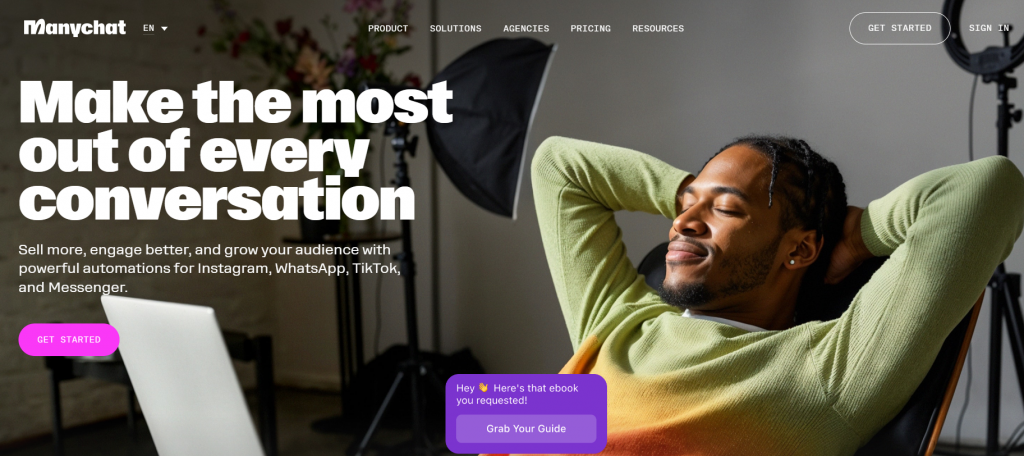
Manychat popularized chatbot marketing with its easy-to-use drag-and-drop flow builder designed specifically for Instagram, Facebook Messenger, and WhatsApp. This platform empowers small businesses and marketers to launch interactive chatbots without any coding knowledge, making it ideal for fast deployment in social media campaigns.
Features
- Visual Flow Builder: Create complex conversational flows using intuitive drag-and-drop tools, allowing you to engage customers with personalized messages and interactive elements like buttons, carousels, and forms.
- Multi-Channel Messaging: Seamlessly communicate with audiences across Instagram, Messenger, WhatsApp, and even SMS, supporting a unified brand voice.
- Automation Tools: Automate drip campaigns, broadcast messages, and user segmentation to nurture leads and drive conversions efficiently.
- AI-Powered Enhancements: Utilize advanced natural language processing features including intent recognition, AI-driven text improvement, and AI steps for intelligent automation like qualifying leads or handling FAQs.
- Growth Tools: Leverage comment triggers, referral links, and landing pages designed to increase user engagement and expand your subscriber base.
- Integrations: Connect with popular marketing and eCommerce platforms like Shopify, HubSpot, Mailchimp, WordPress, and Google Analytics for seamless data synchronization and reporting.
- Analytics: Track message open rates, click-through rates, conversation pathways, and customer behaviors to continuously optimize your chatbot performance.
Strengths
- Quick setup ideal for marketers with no technical background
- Broad template library for marketing automation use cases
- Effective for promotional campaigns and lead nurturing
Limitations
- AI primarily rule-based with limited natural language understanding
- No persistent memory, so conversations do not retain history or context over time
- Workflow automation tailored mainly toward marketing sequences, lacking operational or customer support depth
Ideal For
- Best suited for small businesses and marketers running social media campaigns focused on building audiences and capturing leads quickly.
Manychat remains a top choice for businesses focused on social media marketing and customer engagement campaigns. It offers robust capabilities for automating common marketing use cases, while maintaining easy accessibility for users without specialist technical skills. However, it has limitations in terms of persistent memory, sophisticated AI learning, and multi-channel operational automation compared to enterprise-focused platforms.
2. Chatfuel

Chatfuel is designed primarily for retail and SMBs, offering a no-code platform to build chatbots on WhatsApp Business API and Facebook Messenger. It focuses on transactional sales workflows, customer support, and product FAQs, making customer engagement seamless through popular messaging channels.
Features
- No-Code Chatbot Builder: Build chatbots without technical skills using a visual, beginner-friendly editor optimized for WhatsApp and Messenger.
- AI-Powered NLP: Train the chatbot using natural language processing to improve understanding of customer questions and automate replies accurately.
- Customer Segmentation Tools: Organize users with CRM-like segmentation to send personalized messages and targeted campaigns.
- Conversation Analytics: Track message performance, response trends, and user behavior to continuously improve chatbot flows.
- Broadcast Messaging: Send promotional updates, announcements, and seasonal campaigns directly to subscribers across messaging channels.
- Keyword Automation: Set up rule-based keyword triggers to instantly respond to common questions and actions.
- Menu-Based Interactions: Guide users with structured menus, quick replies, and button-based navigation for smoother conversations.
Strengths
- Specialized for WhatsApp-based commerce and customer communication
- Supports live agent escalation and payment gateway integration
- Wide template offerings tailored to retail use cases
Limitations
- AI capabilities moderate compared to truly self-learning platforms
- Workflow automation limited to transactional logic, without more complex operational flows
- Setup more involved relative to Manychat, with limited channel diversity
Ideal Users
Well-suited for ecommerce brands seeking to automate sales and customer service on WhatsApp and Messenger targeting SMB audiences.
3. YourGPT
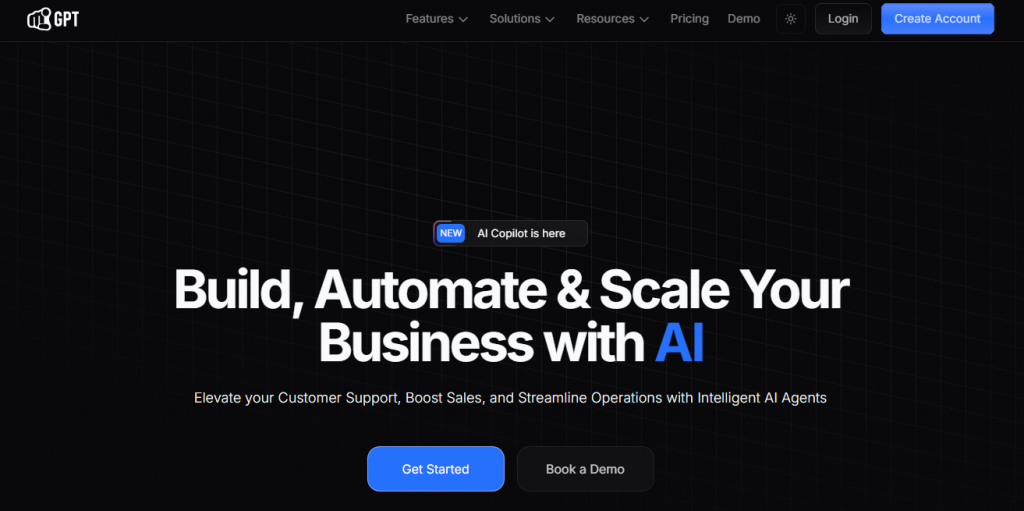
YourGPT is an AI-first platform to build and run AI agents for customer support, sales, and operations across websites, apps, and messaging channels. It offers a no-code builder for regular agents and an AI Studio for advanced operational workflows. So teams have flexibility to create both simple and advanced Agents without technical effort.
Features:
- AI Agent Builder : Create intelligent agents with a no-code builder using intents, routing, and data capture.
- Training from Multiple Sources : Websites, documents, sitemaps, Sheets, Notion, help centers, and past chats all auto-synced.
- Omnichannel Deployment: Deploy on Web, WhatsApp, Instagram, Messenger, Telegram, Slack, Email, and Voice. View and manage every conversation across all channels in a single dashboard.
- AI Studio : Build multi-step flows with logic, conditions, API calls, and backend actions. Run advanced operations using custom code, server actions, and multi-step automations.
- Multi-Model & Multi-Modal AI : Choose models based on speed or accuracy and support text, images, and audio inputs.
- Real-Time System Actions : Update CRMs, eCommerce platforms, or internal apps directly through AI-driven actions.
- MCP Integration : Connect agents to custom MCP tools for real-time actions and complex workflows.
Strengths
- Multi-model AI for accuracy, cost control, and speed
- No-code builder that supports simple and advanced workflows
- Unified deployment across web, apps, and messaging
- Real-time actions through APIs, CRM/eCommerce integrations, and MCP
- Works for support, sales, onboarding, order management, and internal ops
Limitations
- Feature-rich platform, so teams may need onboarding to use everything
- Not ideal if a business don’t want ai platform
Ideal Users
- Ecommerce brands handling 50+ daily customer inquiries about order status, returns, product recommendations, and cart abandonment
- SaaS and service businesses automating lead qualification, trial onboarding, appointment scheduling, and feature adoption triggers that move prospects through the sales pipeline
- Support teams replacing separate tools for live chat, email, WhatsApp, and knowledge base with one workspace where AI handles tier-1 questions and seamlessly escalates complex issues to human agents mid-conversation
- Operations teams connecting Salesforce contact updates, Google Sheets sync, Slack notifications, and database operations through automated workflows without writing code
Comparison: YourGPT vs Manychat vs Chatfuel
Businesses in 2026 face a pivotal decision when choosing a chatbot platform. The market has evolved beyond simple automation, and the choice is about balancing ease of use with advanced AI capabilities to support customer support, sales, marketing, and operations.
Here’s a side-by-side comparison of YourGPT, Manychat, and Chatfuel across key dimensions like AI capabilities, integrations, workflow automation, and scalability, highlighting which platform aligns best with your business needs.
Feature Comparison Table
| Feature | YourGPT | Manychat | Chatfuel |
|---|---|---|---|
| Easy Setup | Yes | Yes | Yes |
| Training and Data | Yes – multi-source including docs, websites, CRM, chat logs | No – limited to templates and predefined rules | Partial – basic AI model training |
| Self-Learning AI | Yes | No | No |
| Persistent Memory | Yes | No | No |
| Advanced Automation | Yes – multi-step workflows, backend API calls, system actions | No – limited to marketing flows | Limited transactional logic |
| Multi-Step Workflows | Yes | No | Partial |
| API and Backend Actions | Yes | No | Limited |
| Omni-Channel Coverage | Yes – web, WhatsApp, Messenger, Telegram, Slack, LINE, email, voice | Partial – WhatsApp, Messenger, Instagram | WhatsApp, Messenger |
| Unified Inbox | Yes | No | No |
| Mobile App | Yes | Yes | Yes |
| Web Extension | Yes | No | No |
| Integrations | Shopify, Salesforce, HubSpot, CRMs, APIs, custom endpoints | Marketing CRMs and eCommerce tools | eCommerce and CRM integrations |
| Brand and Workflow Control | Full control with adaptive paths and fallback logic | Limited – templates and standard flows | Limited workflows and branding |
| Analytics and Reports | Advanced AI-driven analytics and business performance reporting | Basic campaign and user analytics | Basic conversation and sales metrics |
| Security and Compliance | SOC2, GDPR compliant | Standard security | Standard security |
| Pricing | Starts at 59 dollars per month – usage-based, no per-seat fees | Starts at 15 dollars per month – limited scope marketing | Usage-based WhatsApp API pricing |
| Best Fit | Enterprises scaling support, sales, operations across channels | Small businesses running marketing campaigns | SMB retailers leveraging WhatsApp for sales and support |
Setup and Ease of Use
- Manychat has a quick setup for marketing campaigns using its flow builder but is limited to predefined marketing sequences and social channels.
- Chatfuel allows easy setup for WhatsApp and Messenger bots, primarily focused on sales and support flows but can be complex for broader workflows.
- YourGPT provides a no-code setup, enabling businesses to deploy AI agents in minutes. Its AI Studio offers a drag-and-drop interface for building advanced workflows, making it flexible from simple FAQs to complex enterprise operations.
Training and Custom Data
- Manychat relies on static templates and rules without adaptive learning or multi-source training.
- Chatfuel offers partial AI training but primarily focuses on keyword and basic NLP models with less depth.
- YourGPT supports multi-source data ingestion including files (PDF, DOCX, spreadsheets), websites, CRM systems, and past chat histories, enabling continuous updating and customized AI training.
Integrations
- Manychat: Integrates with marketing CRMs and eCommerce tools like Shopify and Mailchimp but lacks backend and operational system integration.
- Chatfuel: Integrates with payment gateways and CRM systems/
- YourGPT: Connects to Salesforce, HubSpot, Stripe, Whatsapp, Twilio, and custom APIs, enabling comprehensive automation and seamless omnichannel experiences.
Workflow Control
Manychat is limited to branded templates and standard flow control without dynamic adaptability.
Chatfuel offers some workflow customization but with limited brand consistency control.
YourGPT allows full customization of conversation paths, fallback logic, and brand tone, enabling bots to adapt mid-conversation, escalate to humans, or switch contexts fluidly.
AI Capabilities
Manychat offers basic AI intents for marketing but lacks real-time system actions or adaptive learning.
Chatfuel uses keyword recognition and AI intent models but without persistent memory or extensive learning.
YourGPT supports advanced self-learning AI driven by multi-source training and continuous improvement. It automates complex real-time workflows and accesses sophisticated AI models for natural language understanding.
Pricing
- Manychat starts at $15/month with tiered pricing based on subscribers, ideal for marketing automation.
- Chatfuel’s pricing starts $24/month.
- YourGPT plan starts at $39/month billed annually.
Choosing the Right Platform Drives Business Success
Selecting a chatbot platform is not just a technology choice, it directly affects key areas of your business:
- Enhance Customer Experience: Advanced AI combined with context retention leads to natural, meaningful conversations that boost customer satisfaction and loyalty.
- Boost Operational Efficiency: Automated workflows reduce manual tasks, speed up resolution times, and free up agents for more complex interactions.
- Drive Sales Growth: Conversational marketing and sales bots nurture leads and help close deals faster and more efficiently.
- Scale Seamlessly: The right platform supports multi-channel and multilingual engagements that grow with your customer base.
- Optimize Costs: Aligning your investment with your business needs, balancing upfront and ongoing expenses, maximizes long-term ROI.
To make the best decision, evaluate chatbot platforms based on their AI capabilities, workflow flexibility, channel support, integration options, scalability, and pricing models. The ideal platform will empower your business to deliver superior customer experiences and operate efficiently as you grow.
FAQ
Which platform is best for customer support automation? ▼
YourGPT handles full support workflows with ticket creation, conversation history, agent handoff, and cross-channel context retention. Manychat focuses on marketing sequences rather than support ticketing. Chatfuel offers basic FAQ responses on WhatsApp and Messenger but lacks unified inbox features or persistent conversation memory.
Can these platforms handle multi-step workflows and API integrations? ▼
YourGPT includes AI Studio for building workflows with conditional logic, REST API calls, database operations, and system actions. Manychat supports basic if-then branching for marketing drip campaigns but cannot execute backend operations. Chatfuel handles linear product browsing and order flows on WhatsApp but lacks advanced workflow capabilities or custom API integration.
What channels does each platform support? ▼
YourGPT deploys on website widgets, WhatsApp, Instagram, Messenger, Telegram, Slack, LINE, Discord, email, and outbound voice calls with a unified inbox. Manychat covers Instagram, Messenger, WhatsApp, and SMS. Chatfuel focuses on WhatsApp Business API and Facebook Messenger only.
How does AI-to-human handoff work on each platform? ▼
YourGPT transfers conversations to human agents with full chat history, conversation notes, and customer context in the same thread. Manychat allows manual takeover but lacks team assignment or context sharing features. Chatfuel supports basic live chat handoff on WhatsApp without collaboration tools or agent performance tracking.
What analytics and reporting does each platform provide? ▼
YourGPT tracks resolution rates, customer satisfaction scores, conversation topics, agent performance, and revenue attribution across support and sales workflows. Manychat provides campaign analytics including open rates, click-through rates, and subscriber growth for marketing sequences. Chatfuel shows message delivery status, conversation volume, and response times specific to WhatsApp and Messenger engagement.
Can I train these platforms on my business data? ▼
YourGPT ingests PDFs, Word documents, spreadsheets, website content, Notion databases, YouTube transcripts, and historical chat logs with automatic syncing. Manychat requires manual flow building without document upload or knowledge base training capabilities. Chatfuel accepts FAQ lists through manual keyword-response pairing but each variation needs individual entry.
Which platform works best for ecommerce stores? ▼
YourGPT connects with Shopify, WooCommerce, and payment processors to handle product inquiries, order tracking, return processing, inventory checks, and cart abandonment across all channels. Chatfuel specializes in WhatsApp commerce with product catalogs, cart management, and order confirmation for stores under 500 items. Manychat automates abandoned cart recovery emails and promotional broadcasts but lacks real-time order management features.
Do I need coding skills to use these platforms? ▼
All three platforms offer no-code visual builders. Manychat uses drag-and-drop for marketing flows. Chatfuel provides a visual editor for WhatsApp and Messenger bots. YourGPT includes both a simple no-code agent builder and AI Studio for advanced workflows, with optional custom code support for developers who want deeper control.
Which platform scales better as my business grows? ▼
YourGPT scales across support, sales, onboarding, and operations with increasing conversation volume and channel expansion without separate tools. Manychat scales for marketing campaign growth and subscriber list expansion on social platforms. Chatfuel handles growing WhatsApp message volume with usage-based pricing but remains focused on messaging-only workflows.
What if I need AI across multiple channels with consistent context? ▼
YourGPT maintains conversation context across web, email, WhatsApp, Instagram, Messenger, Telegram, Slack, and voice with a unified inbox and persistent memory. Manychat operates separately on each channel (Instagram, Messenger, WhatsApp) without cross-channel context sharing. Chatfuel keeps conversations isolated within WhatsApp and Messenger with no cross-platform continuity.
Conclusion
Manychat and Chatfuel work well if you’re running marketing campaigns on Facebook and Instagram or managing sales through WhatsApp. They’re good starting points for smaller businesses trying out chatbot automation.
YourGPT is a better fit if you need more than social media bots. It handles support requests, works across multiple channels at once, and connects with the tools you already use. Businesses that want one system for customer conversations in support, sales, or operations will find YourGPT matches those needs better.
The platform you choose depends on where your customers are and what you need the chatbot to do. If it’s social media marketing, Manychat or Chatfuel will get the job done. If you’re managing customer relationships across different channels, YourGPT offers that flexibility.
Ready to Move Beyond Basic Chatbot Builders
If you are comparing Manychat, Chatfuel, and YourGPT, think about what you need next. YourGPT gives you AI agents that use your data, run workflows, and work across channels so you are not limited to simple marketing flows.
Built for teams that want AI agents that can answer, act, and update systems
Leave a Reply